

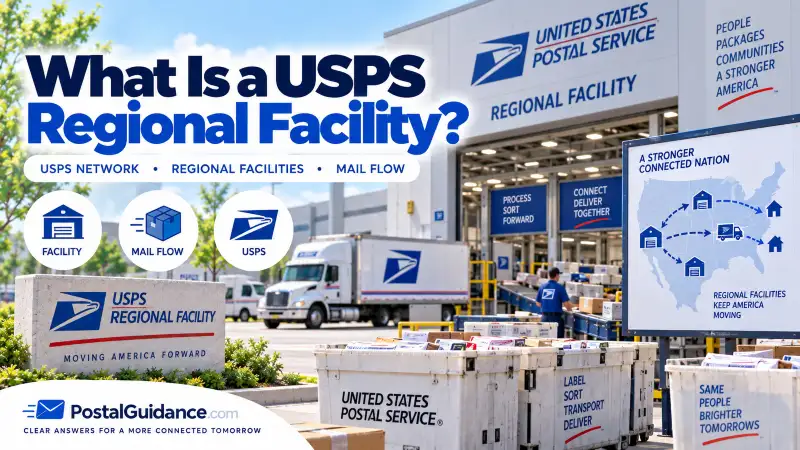
A USPS Regional Facility is a large mail processing center where packages are sorted, routed, and prepared for the next leg of their trip. It is not a delivery location and not a sign that anything is wrong. Seeing it in tracking simply means your package is moving through USPS’s internal network as designed.
When a package reaches a regional facility, USPS systems decide where it should go next, not when it will be delivered. That distinction is the root of most confusion. These facilities sit between national processing hubs and local post offices, acting as routing checkpoints that move mail closer to the correct geographic area. That is why tracking can mention a regional facility even when delivery still feels far away.
If you have seen messages like Arrived at USPS Regional Facility or Departed USPS Regional Facility, your package has entered this internal logistics stage.
Why USPS uses regional facilities
USPS handles millions of packages every day. Moving each one directly from origin to destination would be inefficient and chaotic. Regional facilities let USPS consolidate mail heading in the same direction, optimize transportation routes, and balance volume across the network. This matters most for ground-based services such as USPS Ground Advantage and Parcel Select, where efficiency drives the routing more than raw speed.
A regional facility is not a delivery location, not your local post office, and not a sign that something has gone wrong. It is simply part of how USPS organizes large-scale package movement, and most packages pass through at least one before reaching their destination.
What happens to a package at a regional facility
When a package arrives, it enters a processing stage focused on sorting and routing, not delivery. USPS scans the package and determines which general direction it needs to travel, which transportation route makes the most sense, and when it can move based on capacity and service level. This is why tracking updates at this stage are broad and non-specific: the package is being prepared for movement, even when that movement is not immediately visible.
Why tracking looks quiet at this stage
Regional facilities handle mail in large batches, not as individual handoffs. Because of that, tracking can pause while packages are grouped and loaded for outbound transport. This is common for ground services and long-distance shipments, so seeing USPS tracking not updating during this stage is usually normal and not a sign of a problem.
How long packages usually stay here
There is no fixed timeline. In many cases a package stays for a short processing window, often one or two business days, and slightly longer during high-volume periods. The key point is that time spent here is part of normal USPS flow, not a delay by default. If you want a realistic delivery window for a given route, our delivery time estimator can help set expectations.
Regional facility vs distribution center
A USPS Regional Facility and a USPS Distribution Center are both part of the processing network, but they serve different purposes. Distribution centers handle very large volumes of mail arriving from many regions at once, breaking down national or multi-state shipments into more manageable flows. Regional facilities operate one level closer to the destination; their role is to direct mail toward the correct geographic area rather than simply process volume.
Because of this structure, a package may move from a distribution center to a regional facility, then continue onward to another facility or a local post office. USPS tracking reflects where a package was scanned, not how close it is to delivery, which is why one shipment shows a distribution center while another shows a regional facility. These labels describe internal processing roles, not urgency or delay.
Regional facility vs local post office
A regional facility is part of USPS’s internal logistics network, while a local post office is part of the final delivery stage. Regional facilities handle sorting and routing decisions; they do not deliver packages to homes or businesses. Local post offices receive mail that is already assigned to a delivery route and a carrier.
This is why a package can appear to move through several facilities before reaching the post office that serves its destination. USPS groups packages heading the same direction before sending them onward, which keeps local offices from being overwhelmed. Seeing a regional facility in tracking does not mean a package is close to delivery; it means the package is moving through the system as designed.
Related tracking statuses you may see
Three tracking messages are tied directly to regional facilities, each covered in more depth in its own guide:
- Arrived at USPS Regional Facility confirms arrival only. The package has been scanned into a regional hub and is being grouped with shipments traveling the same direction. It does not mean the package is out for delivery or delayed.
- Departed USPS Regional Facility means processing at that facility is complete and the package has been sent onward, to either another facility or a local post office. Updates often slow after a departure scan, since USPS does not track movement between every point.
- In Transit to Next Facility is a system-generated status showing the package is moving between locations but has not yet been scanned at its next stop. It can repeat while the shipment is between scans and does not signal a delay on its own.
When a regional facility delay is actually a problem
In most cases, time spent at a regional facility is normal. A delay may be worth watching if tracking has not changed for an extended period, the delivery estimate has disappeared or shifted significantly, or the same status repeats far beyond the typical window. Even then, regional facilities handle volume in waves, so what looks like a delay is often a backlog clearing in batches rather than your specific package being held aside.
Common reasons delays happen
Delays here are usually caused by system-wide factors rather than individual package issues: high seasonal volume, weather disruptions, transportation constraints, or staffing and capacity limits. In these cases packages resume moving once conditions normalize, even if tracking does not immediately reflect progress.
What a delay does not mean
A delay at a regional facility does not automatically mean your package is lost or damaged, and it rarely means you need to do anything. Most shipments resume normal movement without intervention. The situations that genuinely require action are uncommon and are usually accompanied by a clear exception message or alert. If a package truly stalls, our guide on what to do when USPS tracking says in transit for days covers the next steps.
Why regional facilities appear so often in tracking
Regional facilities show up frequently because they are central checkpoints in how USPS moves mail across the country. Most packages do not travel in a straight line from sender to recipient; they move through a network built to consolidate volume, optimize routes, and balance capacity. Regional facilities sit at key points in that network, so they appear in tracking more often than smaller locations.
It is not unusual to see the same regional facility mentioned more than once. That can happen when a package is scanned at different processing stages, staged before outbound transport, or updated to reflect internal routing decisions. These repeated mentions usually indicate internal movement rather than backtracking or errors. Tracking language at this stage is intentionally broad because USPS prioritizes operational efficiency over step-by-step public updates. USPS describes how its ground network moves packages on the official USPS Ground Advantage page.
The bottom line
A USPS Regional Facility is a normal and essential part of how USPS moves packages efficiently across the country. Seeing this term in tracking does not mean something is wrong; in most cases it simply means your package is being sorted, routed, and prepared for its next stage of travel. Because these facilities are built to handle volume rather than individual deliveries, tracking updates here can feel slow or vague even when everything is moving as expected. Understanding what a regional facility does removes most of the uncertainty and sets realistic expectations for delivery, especially for ground-based shipping.


very helpful post. got the answers i was looking for, thanks!
Glad it helped, Robert, thanks for letting us know.
My package has been sitting at the distribution center in Brookville In since April 17, 2026
When a package parks at one distribution center like that, it is usually a backlog or a missort rather than a loss. Give it a couple more days, and if it still has not moved, file a Missing Mail search at usps.com/help/missing-mail.htm so the destination office starts looking. Our guide on the USPS regional facility status explains what that stage is doing and when the wait crosses into a real problem.