
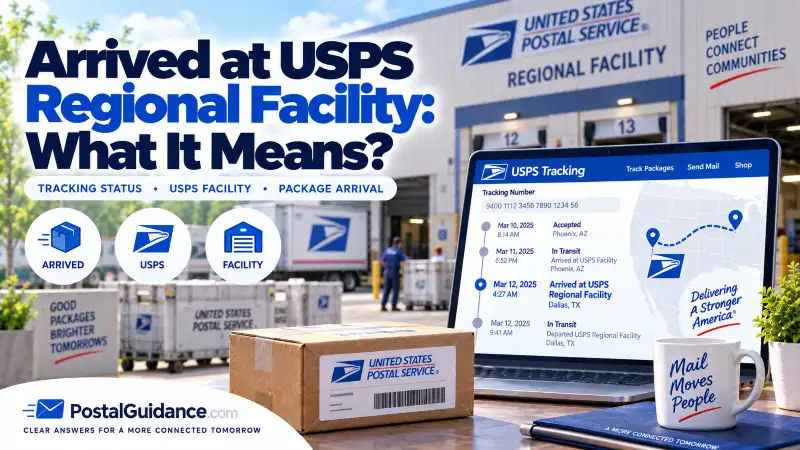
“Arrived at USPS Regional Facility” means your package has reached a large regional sorting center and been scanned in. It is a normal, usually good update: your package is moving through the USPS network as planned, not lost or stuck. The status feels alarming only because it is vague and often followed by a stretch of silence.
A regional facility is a major middle checkpoint, not your local post office and not the last stop before delivery. It handles packages arriving from many cities and states, then scans, sorts, and routes each one onward. For the full picture of what these centers do, see our guide on what a USPS regional facility is. This page focuses on what the “Arrived” scan specifically means and what happens next.
What happens after your package arrives
Arriving at a regional facility does not mean your package immediately hops on a truck and leaves. It moves through a short behind-the-scenes process:
- Arrival scan. This is the scan you are seeing. It confirms the package made it into the facility. USPS now knows where it is, even if no further updates appear right away.
- Sorting and routing. Automated systems read the barcode, weigh the package, and decide its next stop, another facility, a distribution center, or your local post office. It can travel internally for hours with no new scan during this stage.
- Waiting for transport. If the facility is busy, the package may sit in a container waiting for the next available truck or plane. It is not lost, just waiting its turn.
- Departure scan. Once loaded, you will usually see Departed USPS Regional Facility or In Transit to Next Facility. That is your sign things are moving again.
USPS does not scan packages at every movement, so even when tracking looks frozen, your package may already be on its way to the next stop.
How long packages usually stay here
In normal conditions, most packages stay at a regional facility from a few hours up to about 24 hours. It is also common for a package to sit for one to three days and still be completely fine, since delivery speed depends on the mail class, destination, and how busy the facility is.
| Time at facility | What it means |
|---|---|
| Same day to 24 hours | Completely normal. |
| 1 to 3 days | Still normal, especially during busy periods. |
| 3 to 5 days | A slight delay, but not alarming yet. |
| 5+ days with no scan | Worth paying closer attention. |
Holidays, weather, staffing shortages, and online shopping spikes can all push timelines back. Remember too that tracking updates do not always match real movement, so a package can leave the facility before its departure scan posts. If yours has genuinely gone quiet, our guide on USPS tracking not updating explains why.
Is this a good sign or a bad one?
Usually a good one. The status tells you two useful things: USPS successfully scanned your package at a major processing point, and the system knows where it is right now. That alone rules out most worst-case fears. It only starts leaning negative if the status does not change for several days, the estimated delivery date disappears or keeps moving back, or you see repeated arrival scans at the same facility. Even then, that usually points to congestion rather than a lost package.
Common reasons packages get stuck
Most packages that appear stuck are not held up by anything wrong with your shipment; the system around them is simply overloaded. The usual causes are high package volume during holidays and sales, weather disruptions to transport (even in a different region), staffing shortages that slow sorting, routing changes that send a package through an unexpected facility, and occasional equipment or system issues. In almost every case the delay is temporary.
What to do if it seems stuck
First, check how long it has actually been sitting there. If it has been fewer than three days, the honest answer is to wait, that is still normal. If it has been three to five days, recheck the tracking details for small changes like a new timestamp or delivery estimate, and give it one more business day, which often triggers the next scan.
If the package has been stuck at the same facility for more than five business days, it is reasonable to act. Submit a USPS Help Request Form rather than calling, since it creates a case number and routes the issue to the destination post office, where real answers usually come from. If it was an online order, contacting the sender can help too, since retailers deal with USPS daily. Avoid filing a missing-mail search too early, as USPS recommends waiting until the package is truly delayed. If it stays stuck, our guide on what to do when USPS tracking says in transit for days walks through escalation.
When to contact USPS, and when not to
Contact USPS if the package has been at the same regional facility for five to seven business days, the estimated delivery date has disappeared and not returned, tracking shows repeated scans at the same facility with no movement, or the contents are time-sensitive or valuable. In those cases, start with the official USPS Help Request Form, not a phone call.
Hold off if it has only been one to three days, the status updated recently, you are in a peak shopping or holiday period, or the delivery date is still active and reasonable. Calling too early almost always gets the same answer: please allow more time. It also helps to know that regional facilities do not deal directly with customers, so you cannot call one or pick a package up yourself, everything moves through the system.
The bottom line
“Arrived at USPS Regional Facility” is a checkpoint, not a warning. Your package reached a major sorting center and is being routed onward. A day or two here is well within normal, even when tracking sits still. Save your energy for when the delay crosses five or more days with no movement, and let the process run until then.