What does in transit mean USPS? It means your package is in the mail network and moving between postal facilities toward your local Post Office. Seeing it does not mean the package is stuck.
USPS uses the label for a long stretch of the trip. A package can sit under it for days while it crosses the country. The words around it tell you more than the two words alone.
What does in transit mean USPS tracking is showing?
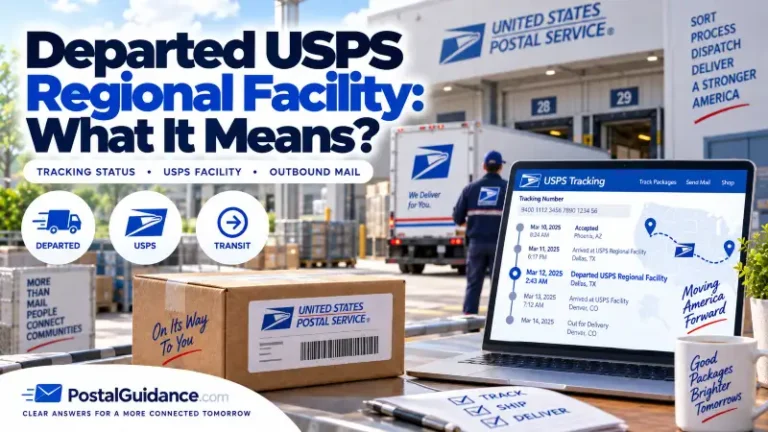
USPS groups “In Transit” with “Arrived at USPS Facility” and “Departed USPS Facility.” Each one means the item is being processed or carried to the Post Office that will deliver it. The wording comes from the USPS tracking status help page.
Your package goes from where it was mailed to a sorting hub. Then it moves to a hub near you and on to your delivery Post Office. Each stop can produce a scan, but a drive between two hubs may not.
That gap explains why tracking can look frozen for a day or two. The next scan only appears when the package reaches the next checkpoint.
Common in transit wordings and what they mean
USPS adds a short phrase after “In Transit” in many cases. Its public status help defines the whole In Transit family with the one sentence above and does not define each suffix separately, so the table reads the suffixes the way USPS uses them in tracking: the first part gives the location, the second part the movement or the estimate.
| Status you see | What it means | What to do |
|---|---|---|
| In Transit / Arrived at USPS Facility / Departed USPS Facility | The package is being processed or moved toward your delivering Post Office. | Wait. Turn on text or email updates. |
| In Transit to Next Facility | It left one facility and is on the way to another; no scan is due until it arrives there. | Wait for the next scan. |
| In Transit, Arriving Late | Still moving, but USPS now expects it after the original estimate. | Wait, then check the new estimate. |
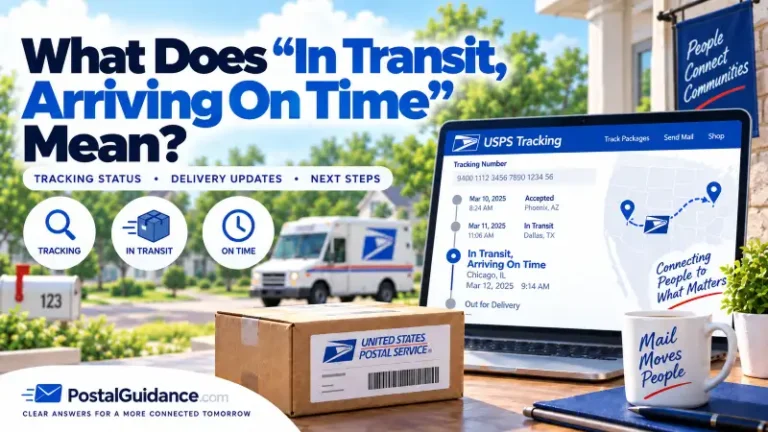
| In Transit, Arriving on Time | Moving, and the delivery estimate still holds. | Nothing to do. |
| Arrived at Post Office | Delivery is expected today or the next business day. | Contact the Post Office if nothing changes within one business day. |
| Out for Delivery | The carrier delivers it today. | Contact the Post Office if it does not arrive within one business day. |
The two “Arriving” phrases describe the estimate, not the location. A late notice does not mean the package is lost. Each wording has its own page: In Transit to Next Facility covers the between hubs case in detail.
The reassuring version is explained in In Transit, Arriving on Time, including why it can still change later.
How long can a package stay in transit?
Many readers who ask what does in transit mean USPS also want to know how long it lasts. No single countdown applies to every package.
USPS says status meanings vary by mail class, the services you chose, and the origin and destination. A package crossing the country takes longer than one going to a nearby city.
USPS publishes no cutoff tied to the In Transit status itself. Your mail class sets the expected speed, and the service page on usps.com lists these windows: Priority Mail Express 1 to 3 days, Priority Mail 2 to 3 days, USPS Ground Advantage 2 to 5 days, First-Class Mail 1 to 5 days and Media Mail 2 to 8 days. Check your route with the delivery time estimator.
Treat the top of that range as the point where in transit stops being routine. A Ground Advantage box on day 3 is on schedule; the same box on day 7 with no new scan is behind.
The most common ground service has its own timing rules, covered in the guide to USPS Ground Advantage. Compare your label against those before you worry.
Why the estimate matters more than the status
Many packages show an expected delivery window. USPS describes it as a 2 hour slot when you can expect the package. Delivery in that slot is not guaranteed, and items may still arrive by the end of the day.
Tracking also updates through the day as scans come in. A status you saw this morning may be out of date by evening. Refresh before you decide anything is wrong.
USPS also uses alert statuses for delays tied to weather and natural disasters. If you see one, check the USPS Service Alerts for your route. These delays are outside the package itself.
What the in transit status does not tell you
Asking what does in transit mean USPS customers see is partly asking what the status hides. It does not name the facility, the truck, or the day the package will reach your door. It only says the item is somewhere in the network and moving.
It also does not tell you the package is on schedule. For that, read the estimate beside it. If the estimate moves later, USPS is telling you the trip is taking longer than planned.
The status also does not mean the carrier has tried delivery. A failed attempt shows up as its own scan. Until you see one, the package has not reached your address yet.
Signing up for text or email updates helps here. USPS suggests this when a package is in transit, so you hear about the next scan without refreshing the page. When the status finally changes to Arrived at Post Office, you know delivery is expected today or the next business day.
Normal vs when to worry
The table separates a package that is moving from one that needs action. The one hard number USPS gives is the 7 day mark for a Missing Mail search.
| Situation | Normal or worry | Next step |
|---|---|---|
| Status changes every day or two, even slowly | Normal | Keep waiting. |
| No new scan for a few days, estimate not passed | Usually normal | Check again tomorrow. |
| Estimate has passed and status is still In Transit | Worth a call | Ask your Post Office or USPS customer service for a check. |
| Arrived at Post Office, no change for one business day | Worry | Contact that Post Office. |
| 7 days since mailing, still no delivery | Worry | File a Missing Mail search. |
For a long gap with no scan, see USPS tracking not updating for the likely causes.
If the package has been moving for days, the post on USPS tracking that says in transit for days covers that case.
What to do if it seems stuck
Start with USPS Tracking and look for the latest scan. Then work through these steps in order.
- Wait until the estimated delivery date has passed. A late estimate is not a lost package.
- Contact your local Post Office if the status says Arrived at Post Office or Out for Delivery and nothing changes within one business day.
- Once 7 days have passed since mailing, submit a Missing Mail search at missingmail.usps.com.
The USPS Missing Mail page lists what you need. Have the sender and recipient addresses, the container type and size, and the tracking number or mailing date. Add an item description and photos.
USPS sends a confirmation email and periodic updates after you file. It then tries to find the item and forward it. USPS warns that it may be unable to recover some items, and some cannot be forwarded safely.
Insured mail has its own limit. Claims for damage or missing contents must be filed no later than 60 days from the date of mailing. Keep your receipt and tracking number.
USPS keeps Tracking records for 120 days. Priority Mail Express and Certified Mail records last 2 years. File before those windows close.
Related status questions
A package can be in transit while you still want to change where it goes. That process is separate. The guide on how to change the USPS delivery address on a package in transit explains it.
If the status points to a third party instead, read about Delivered to Agent for Final Delivery. It is a different case from a package still moving.
Bottom line on in transit
In transit is the normal middle of a delivery. It only becomes a problem when the estimate passes with no movement. Wait for the next scan, watch the estimate, and use the 7 day Missing Mail rule if the package never shows up.