Priority Mail International leaves the counter looking almost exactly like a domestic Priority Mail box. Then it disappears into another country’s postal system for a stretch. It comes back to life at someone’s front door, sometimes with a duty bill attached.
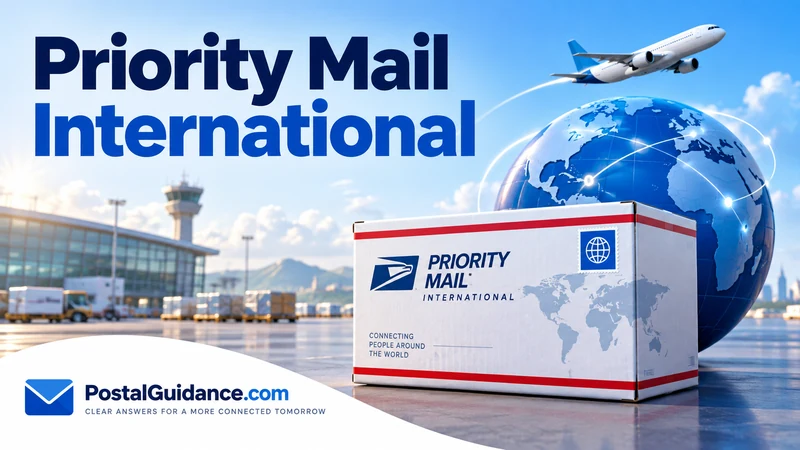
Priority Mail International is the USPS service for sending packages from the United States to about 180 countries. Tracking comes with most versions. So does a little insurance, and USPS publishes a window of 6 to 10 business days.
It is not the cheapest way to ship overseas, and it is not the fastest. It sits in the middle, which is honestly where most people shipping a box abroad want to be.
Below is current pricing and what happens at customs in 2026. I also cover the prepaid duty option USPS rolled out this year, and when Priority Mail Express International or First-Class Package International Service beats it.
What priority mail international actually is
Priority Mail International is the overseas cousin of domestic Priority Mail, run through the same network but with customs paperwork attached. You pack a box or use one of the flat rate options. You print a customs form and hand it off at a post office.
A blue collection box will not work here. International mail needs customs paperwork attached and accepted at the counter or by a carrier.
The service covers packages up to 70 pounds. Combined length and girth tops out at 108 inches for standard boxes. Flat rate versions cap lower: 4 pounds for the envelope and small box, 20 pounds for medium and large.
How to actually ship one
Two paths get you there. Print the label and customs form at home through Click-N-Ship. Then drop the package at any post office or hand it to a carrier.
Or walk into a post office with the item unsealed. Staff sometimes want to see the contents to help fill out the customs form correctly.
If it were me, I’d do it online every time. Click-N-Ship charges the commercial price, which runs a bit under the counter rate. You also fill out the customs form at your kitchen table instead of in a line.
It also generates the barcode that lets USPS send your customs data electronically ahead of the package. That head start can speed up clearance on arrival.
Priority mail international prices right now
USPS updates international pricing on its own schedule, separate from domestic rates. The numbers below come straight from usps.com in September 2026. Commercial pricing through Click-N-Ship runs a dollar or two under the counter price on every flat rate option.
| Option | Retail (counter) | Commercial base | Max weight |
|---|---|---|---|
| Weight based standard box | starts at $43.55 | varies by weight and zone | 70 lbs |
| Flat Rate Envelope | $32.65 | $31.61 | 4 lbs |
| Small Flat Rate Box | $33.75 | $32.66 | 4 lbs |
| Medium Flat Rate Box | $61.80 | $59.69 | 20 lbs |
| Large Flat Rate Box | $75.15 | $73.24 | 20 lbs |
Flat rate only pays off once a box gets heavy for its size. A light item in a large flat rate box will almost always cost less shipped as a weight based package. Confirm your exact number on USPS’s own international price page before you commit.
Zone pricing shifts the weight based number country by country. A quote to Canada and a quote to Australia will not match, even at the same weight.
How long priority mail international actually takes
USPS publishes 6 to 10 business days for most major markets. That is a target, not a promise. There is no money back guarantee attached to this service.
Real delivery time depends on the destination and on how backed up customs is that week.
A package to Canada or the UK often lands closer to the low end. A package heading somewhere with slower customs can sit well past 10 business days.
So can one mailed during a holiday surge. Neither means anything is wrong.
If a package looks stuck, how long customs clearance typically takes is worth reading before you assume the worst.
Tracking coverage, and the gap nobody mentions
Priority Mail International includes USPS tracking. That is one of its main advantages over the cheaper options.
But it is not on every version. USPS’s own service page states that tracking is not available for the Flat Rate Envelope or the Small Flat Rate Box.
That surprised me the first time I read it, and it trips up plenty of sellers. If a customer needs scan by scan visibility, use the medium box, the large box, or a weight based package. The envelope and small box will not give it to you.
Once a package clears US processing and lands overseas, scan frequency depends on that country’s own postal system. Some countries scan at nearly every stop. Others show one scan on departure and nothing again until delivery.
Insurance that comes with the service
Priority Mail International includes some insurance automatically, and it is smaller than a lot of sellers expect. Nonnegotiable documents are covered up to $100 for reconstruction. Merchandise, meaning gifts and other goods, is covered up to $200 for loss, damage, or missing contents.
For anything worth more, buy extra insurance at the counter or through a shipping platform. A claim on an international package takes longer than a domestic one. USPS has to coordinate with the destination country’s postal operator before it pays out.
Customs forms: which one you actually need
Every shipment needs a customs form, and for this service the answer is simple. The International Mail Manual, Exhibit 123.61, says every Priority Mail International item uses PS Form 2976-A, at any value. That includes the Flat Rate Envelope and Small Flat Rate Box.
You will see older guides claim the short PS Form 2976 works for the envelope and small box under $400. That rule belongs to First-Class Package International Service now, not this one.
If you build the label online, USPS generates the right form automatically. It only matters when you fill one out by hand at the counter.
Fill it out honestly and specifically. ‘Gift’ or ‘merchandise’ is not a real description. ‘Cotton t shirt’ or ‘used paperback book’ is.
A vague description is one of the most common reasons a package gets pulled for a closer look.
The de minimis changes and what they mean for your package
In August 2025, the United States ended its own de minimis exemption, the rule that let low value goods enter the country duty free. That change affects packages coming into the US. It does not set what a recipient abroad owes on a Priority Mail International package leaving the US.
Plenty of guides mix those two directions up. What decides your recipient’s bill is the destination country’s own threshold, and those have been tightening everywhere.
The European Union is the clearest example. Since July 1, 2026, EU countries charge a flat 3 euro duty on business to consumer packages worth up to 150 euros. Those used to enter duty free, and gifts between 45 and 150 euros get the same charge.
USPS’s own DDP page spells this out. The 3 euro charge applies per unique HS code in the package.
VAT has applied to nearly all EU imports regardless of value since 2021, so that part is not new. Every destination sets its own rules, and they shift often enough that guessing is a bad plan.
For shipments heading north, the full breakdown of Canadian duty and tax rules covers that country in detail.
USPS Delivered Duty Paid: the new option that changes this
In early 2026, USPS rolled out Delivered Duty Paid, usually called DDP, for outbound international mail. It applies to Priority Mail International, Priority Mail Express International, and First-Class Package International Service.
DDP lets you prepay the duties, taxes, and fees a destination country will charge. You pay it when you buy postage. Full details sit on USPS’s prepaid import duties page.
USPS does not charge its own fee for this. The third party provider builds a service fee into the quoted total. If customs charges the recipient more than you prepaid, USPS says the provider covers the difference, within its terms.
The upside is real. A recipient who gets a DDP package does not face a surprise bill or a customs hold demanding payment before delivery.
USPS also says prepaying can streamline clearance and potentially improve delivery times. Sellers on eBay’s forums describe unpaid duty shipments sitting far longer than prepaid ones when customs volume runs high. That reporting is mostly about packages entering the US, so treat it as a pattern rather than a rule.
DDP is worth the extra step if you sell overseas regularly, or for a gift the recipient did not expect to pay for. For a one off box to a relative who already expects a small VAT charge, skipping it is fine.
Who actually pays the duty
The recipient pays, not the sender, unless you use DDP or the destination’s own rules shift that burden to the seller. That surprises plenty of first time senders.
USPS collects postage from you and stops there on a standard shipment. The destination country’s postal operator usually collects duty and a handling fee before the recipient gets the package. Sometimes they bill afterward instead.
Refusing a package to dodge the charge is possible in most countries. It usually means the item gets returned or destroyed, and your postage is gone either way.
Our international duty and customs estimator gives a reasonable number before you ship. Nobody on the other end gets caught off guard.
Priority mail international vs Priority Mail Express International
Priority Mail Express International is the faster, pricier sibling. It runs 3 to 5 business days to many destinations against the 6 to 10 for standard service. It also carries a money back guarantee to a specific list of countries when mailed at a post office counter.
Express starts around $64.25 retail, with its own flat rate envelope at $62.70. That is close to double the standard flat rate envelope.
Choose Priority Mail Express International when the date genuinely matters, like a document with a deadline. Otherwise the extra $30 buys you a few days you probably do not need.
When First-Class Package International Service is the better call
First-Class Package International Service, sometimes called FCPIS, is the budget option below Priority Mail International. It caps out at 4 pounds and a declared value of $400. It starts around $19.40 retail, with delivery confirmation to 80 plus destinations rather than full tracking everywhere.
It makes sense for light, inexpensive items where a few extra days do not matter. A small paperback, a phone case, or a light gift under 4 pounds often ships cheaper this way than in a flat rate envelope.
For letters and documents rather than packaged goods, First-Class Mail International is the right comparison. It is built for envelopes, not parcels.
When it is normal versus when to worry
Normal: a package shows one or two scans in the US, then goes quiet for several days while it crosses and clears customs. Scanning picks back up in the destination country’s network. That gap alone is not a red flag.
Worth watching: zero movement for more than 10 business days with no customs activity showing at all. Or a status that says the item is held pending duty payment for an unusually long stretch. At that point, calling USPS at 1-800-275-8777 or filing a Missing Mail search is a reasonable next step.
Genuinely worrying: tracking shows the package returned to sender with no reason given. Or a customs hold sits unresolved for weeks with no update from the destination carrier. Those situations usually need a claim, not more patience.
For what happens once a package lands in another country’s customs system, see how customs processing works from the destination side.
Bottom line
Priority Mail International is the sensible middle option for shipping overseas. You get real tracking on the boxes and weight based packages, plus a modest slice of insurance. The 6 to 10 business day target usually holds.
Check current pricing for your exact destination before you ship, and describe the contents honestly on the customs form. Decide up front whether you or the recipient covers the duty. With DDP that is finally a choice instead of a surprise.