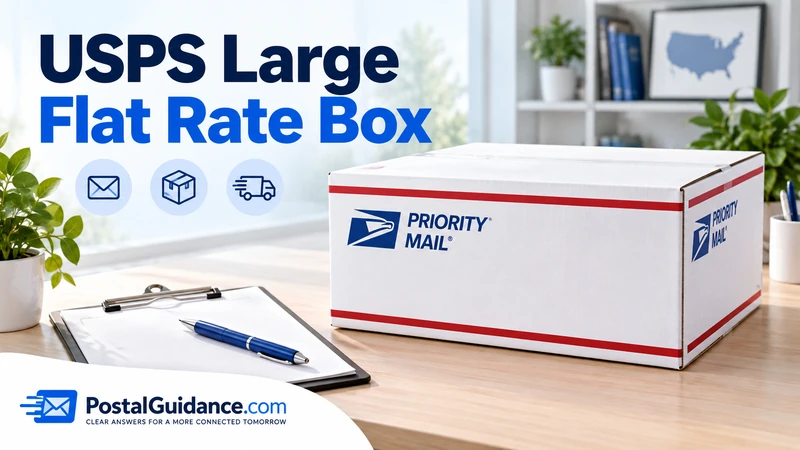
A laptop and a board game need two completely different box shapes. USPS still prices both at exactly $34.00. That is the large flat rate box in a nutshell: one fixed price, two very different container shapes.
Most shippers only know the square version exists. The long, flat second variant solves a shape problem the square box cannot handle.
Here is everything about the large flat rate box, both versions, current pricing, and when a different USPS option actually costs less.
The two large flat rate box variants
USPS sells the standard Large Flat Rate Box and the Large Flat Rate Board Game Box. Both cost the same $34.00 at the counter. Online commercial pricing brings that down to $31.00.
| Variant | Outside dimensions | Inside dimensions | Price |
|---|---|---|---|
| Large Flat Rate Box | 12.25 x 12 x 6 in | 12 x 11.75 x 5.5 in | $34.00 retail |
| Large Flat Rate Board Game Box | 24.06 x 11.88 x 3.13 in | 23.69 x 11.75 x 3 in | $34.00 retail |
Both cost the same despite the board game version running roughly twice as long. USPS built the second shape for a specific reason. Standard board games rarely fit a square box without folding the lid.
What actually fits in the standard large box
USPS lists laptops, computers, and general gifts as the intended contents. Anything roughly shoebox sized to slightly larger fits comfortably inside its 5.5 inch interior depth.
Shoes, kitchen items, and stacked clothing are common real world contents. Sellers on eBay’s community forum report all three regularly. Depth is the limiting factor more often than length or width.
What actually fits in the board game box
The board game variant exists for one job. It ships an actual board game box without crushing it. At just over 3 inches deep, it holds most standard game boxes with no extra padding needed.
It also works for other long, flat items. Framed art, posters in a flat mailer, or thin electronics can all use the extra length instead of an oversized envelope.
The APO/FPO large flat rate box
A third version shares the exact same outside and inside dimensions as the standard large box. It is priced specifically for military addresses, at $32.55 retail instead of $34.00.
That box only applies to shipments headed to an APO, FPO, or DPO address. Anyone shipping domestically should stick with the regular Large Flat Rate Box instead, since the military pricing does not apply outside that use case.
The 70 pound weight limit
Both large flat rate box variants ship up to 70 pounds at the same fixed price. USPS Tracking comes included automatically. Up to $100 of insurance is built into the shipment too.
A heavy, dense shipment near that 70 pound ceiling gets the biggest savings from the large flat rate box. Weight stops mattering once you commit to the fixed price.
When weight based pricing beats the large flat rate box
A light item that merely happens to be large loses money under flat rate pricing. Weight based Priority Mail charges by actual weight and zone instead. It often costs less when the box sits nowhere near full.
Flat rate packaging does carry one real advantage that your own box does not get. USPS exempts all flat rate packaging from its nonstandard package fees. Those fees can otherwise add several dollars to an oddly shaped shipment.
Our dimensional weight calculator can estimate the real charge for a light item in your own packaging. Compare that figure against the fixed $34.00 price before choosing.
Priority Mail Cubic: the option most guides miss
Regional Rate boxes were once a common comparison point against flat rate pricing. USPS discontinued them as a separate rate structure back in January 2023. Any guide still recommending them describes an option that no longer exists.
USPS now points commercial shippers toward Priority Mail Cubic instead. It prices by the actual outer volume of your own packaging rather than a flat fee. Eligible packages must stay at 0.5 cubic feet or less and 20 pounds or less.
A large flat rate box holds roughly 0.45 cubic feet inside, just under that Cubic threshold. A light shipment that fills the box without approaching 70 pounds can sometimes cost less through Cubic pricing. It does require a commercial USPS account to access.
Retail counter customers cannot select Cubic pricing directly. It runs through approved shipping software and a linked USPS business account, which rules it out for anyone shipping a single package at the counter.
Choosing between the large box and the medium size
The jump from Medium to Large Flat Rate pricing runs from $24.80 to $34.00. That gap is worth checking before defaulting to the bigger box. Our complete free box lineup covers every size in both families side by side.
For paperwork or thin items that never needed a box, our guide to the envelope options for lighter items covers the cheaper alternative.
Try the flat rate box selector tool to compare your exact item against every size at once, including both large box variants.
Ordering the large flat rate box for free
Both large box variants ship free through USPS.com. No purchase is required. Packs of 10 or 25 are available online, and single boxes wait at any post office counter.
Full sizing and current stock for the standard box sit on the large box listing on USPS.com.
Our guide to every flat rate size and current price covers how this box fits into the full lineup.
The bottom line
The large flat rate box comes in two shapes for one price. A square version handles bulky items, and a long version was built for board games and flat items. Both ship up to 70 pounds for $34.00.
It earns its price on heavy, dense shipments near that weight limit. Light items in a mostly empty box usually cost less under weight based pricing or Priority Mail Cubic instead.