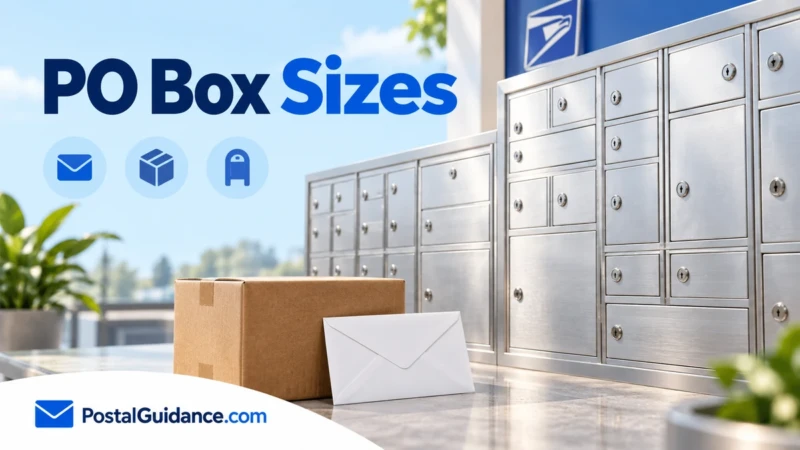
USPS rents five PO Box sizes. They run from a small letter slot up to a box built for parcels. All five share the same 14.75 inch depth.
Only the width and height change between sizes. That is what actually decides how much mail and how many packages fit.
Most individuals only need the two smallest sizes. Frequent shoppers, resellers, and small businesses usually need one of the three larger ones. Picking the right size matters beyond convenience, since a box that is too small means constant trips for overflow parcels.
The five PO Box sizes and their real dimensions
Every size is 14.75 inches deep. Here are the official width and height measurements for each.
| Size | Dimensions (W x H x D) | What it holds |
|---|---|---|
| Size 1, X-Small | 3 in x 5.5 in x 14.75 in | 10 to 15 letters or up to 2 rolled magazines |
| Size 2, Small | 5 in x 5.5 in x 14.75 in | 10 to 15 letters or up to 5 rolled magazines |
| Size 3, Medium | 11 in x 5.5 in x 14.75 in | Large envelopes and magazines stacked flat |
| Size 4, Large | 11 in x 11 in x 14.75 in | About 2 shoebox sized packages, plus 10 to 15 letters |
| Size 5, X-Large | 22.5 in x 12 in x 14.75 in | Flat Rate Boxes and multiple parcels |
If you regularly ship as well as receive mail, our Priority Mail flat rate box tool can help you check which box options will actually clear an X-Large slot.
Notice the pattern. Size 3 only adds width over Size 2, not height. That is why it favors flat items like large envelopes.
Size 4 adds height too. That extra height is what actually creates room for boxed packages.
Which size fits your mail, by situation
An X-Small or Small box covers most individuals. If your mail is mostly bills and letters, you will rarely fill either one before the next pickup.
A Medium box suits anyone who gets a steady flow of large envelopes, magazines, or catalogs. It is the smallest size built to lay mail flat instead of forcing it to bend.
A Large box fits people who order online somewhat regularly. Two shoebox sized packages is enough room for a typical week of small parcels alongside your letters.
An X-Large box is built for volume. Online resellers and small businesses processing returns should size up to this one. For the price difference between sizes, see our breakdown of PO Box costs by size.
What actually happens when a package does not fit
USPS never forces a package into a box it cannot hold. If a parcel is too large for your size, you get a paper notice instead. Some locations issue a key to a separate parcel locker.
You then collect that oversized item at the counter or the locker on your own schedule. This happens occasionally with any size.
It becomes routine if you consistently rent a box too small for what you receive. Routine oversized notices are the clearest sign it is time to size up.
Changing your size after you already have a box
You are not locked into your original size for the life of the box. You can request a different size at your Post Office, subject to availability at that location.
Sizing up usually means paying the price difference for your remaining rental term. Sizing down works the same way in reverse, though not every location offers a downgrade mid term.
Availability is the real constraint. A specific size can sell out at a popular Post Office even when another size stays open. Ask before assuming a change is possible on the spot.
Sizes are not available everywhere
Not every Post Office stocks all five sizes. Smaller offices sometimes skip the X-Large size entirely.
Busy urban offices can sell out of the smallest sizes first, since so many people want the cheapest option. Check live availability for your specific location on the official USPS PO Box page before you plan around a size that may not be in stock.
If your first choice is unavailable, a nearby Post Office in the same ZIP range often carries it.
Sizing for a business or reseller account
Business volume changes the math. A company receiving daily mail alongside regular parcels usually needs at least a Large box.
Resellers shipping returns through a PO Box should lean toward the X-Large size if their Post Office carries it. The larger footprint absorbs return volume spikes around holidays.
That extra room avoids forcing extra counter visits during a busy season. For the full application process, including the extra paperwork a business needs, see our guide to how to get a PO Box. Once your box is set up, get the exact PO Box address format right so customer returns and mail actually reach the counter.
Frequently asked questions
What are the 5 PO Box sizes?
USPS offers X-Small, Small, Medium, Large, and X-Large. All five are 14.75 inches deep, and the width and height grow from a small letter slot up to a size built for multiple parcels.
What PO Box size do I need for packages?
A Large box fits about two shoebox sized packages plus letters, which covers occasional online orders. Frequent shoppers or resellers usually need the X-Large size instead.
Can I change my PO Box size later?
Yes, in most cases. You can request a different size at your Post Office, though it depends on availability and usually means paying the price difference for the remaining term.
What happens if my package does not fit in my PO Box?
USPS leaves a pickup notice or a parcel locker key instead of forcing it in. You collect the item at the counter or locker, which becomes a routine hassle if it happens often.
Is every PO Box size available at every Post Office?
No. Smaller locations may not carry the X-Large size, and popular locations can sell out of the smallest, cheapest sizes first. Check live availability for your specific Post Office before you plan around one size.
What is the smallest PO Box size?
Size 1, the X-Small, measures 3 by 5.5 by 14.75 inches. It holds roughly 10 to 15 letters or a couple of rolled magazines between pickups.
The bottom line
The five PO Box sizes share the same depth and differ only in width and height. That difference is what decides real capacity.
Most individuals do fine with an X-Small or Small box. Frequent package recipients and small businesses should size up to Large or X-Large instead.
Match the size to your actual mail and package volume, and confirm it is in stock at your chosen Post Office before you apply. Once you have picked a size, our guide to what a PO Box is and how it works covers everything else involved in setting one up.