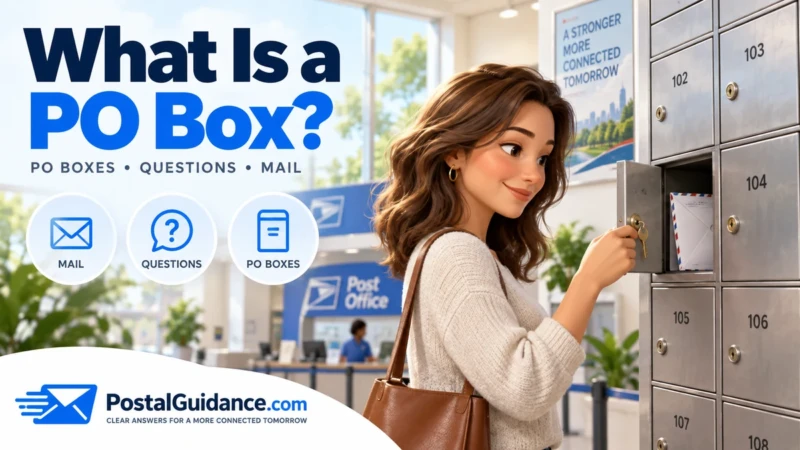
A PO Box is a locked, numbered mailbox you rent inside a Post Office. USPS delivers your mail to it, and you pick it up on your own schedule. It gives you a private address that is not your home, and it can even receive packages.
People rent a PO Box for privacy. Others want protection from mailbox and porch theft. Many just need a stable address when they move often or run a small business.
It is one of the oldest USPS services. It still works much the way it always has. What changed is the range of sizes, the online application, and the option to receive parcels from UPS and FedEx.
What a PO Box is, in plain terms
A PO Box, short for Post Office Box, is a private mailbox with its own number. It sits behind the counter wall at a Post Office. Only you and Post Office staff can reach it.
Your mail is sorted into the box on delivery days. You collect it with a key or a lock combination. Because the box sits inside a Post Office, your mail never waits in an unsecured curbside mailbox.
Your address takes the form PO Box 1234, then the Post Office city, state, and ZIP code. A PO Box is not a mailbox at your house. It is also not the same as a private mailbox from a store like the UPS Store.
PO Box vs a home mailbox vs a private mailbox
These three get mixed up, so it helps to separate them. A home mailbox is the one at your curb or door, filled by your carrier. A PO Box is a USPS box inside a Post Office that you rent and check yourself.
A private mailbox, often called a PMB, is different again. Stores like the UPS Store rent them, and they give you a standard street address. A PMB usually costs more, but it accepts UPS and FedEx with no extra setup.
The short version is simple. A PO Box is USPS run, secure, and cheaper. A PMB is store run, pricier, and more flexible for parcels.
How a PO Box works day to day
Once your box is assigned, the routine is simple. USPS places your incoming mail in the box on every delivery day. You pick it up whenever it suits you.
Access hours depend on the location. Many Post Offices open the box lobby earlier and later than the service counter. Some even offer 24 hour lobby access.
Packages are handled a little differently. Small parcels go straight into the box. Anything too large triggers a notice slip, or a key to a bigger parcel locker.
You then collect the oversized item at the counter or from that locker. You can also turn on free alerts through USPS Informed Delivery. It shows images of your incoming letters and flags packages waiting for pickup.
Informed Delivery is the most useful extra for a box holder. It saves wasted trips to an empty box. Accountable mail works at a box too, and you can even send certified mail to a PO Box.
Keys occasionally get lost, and USPS has a simple process for that too. See our guide to replacing a lost PO Box key for the form and fee involved.
The five PO Box sizes
USPS offers five sizes. They run from a small slot for letters up to a box that holds several parcels. Here is what each one is built for.
| Size | Dimensions | Roughly fits |
|---|---|---|
| Extra small (Size 1) | 3 by 5.5 in | 10 to 15 letters and a few rolled magazines |
| Small (Size 2) | 5 by 5.5 in | More letters plus one small flat rate box |
| Medium (Size 3) | 5.5 by 11 in | Stacked large envelopes and two small flat rate boxes |
| Large (Size 4) | 11 by 11 in | Small and medium flat rate boxes with room for letters |
| Extra large (Size 5) | 12 by 22.5 in | Multiple packages at once |
Most individuals do fine with an extra small or small box. Frequent shoppers and small businesses lean toward the larger sizes. For help matching a size to your mail volume, see our guide to PO Box sizes.
What a PO Box costs
There is no single price. The cost comes down to two things. It depends on the size you pick and how busy your Post Office location is.
USPS sorts locations into fee groups. The same box costs a fraction as much in a rural town as it does in a competitive city. Size then adds to that base rate.
As a rough guide, the smallest boxes can start in the low tens of dollars for six months in lower cost areas. The largest boxes in high demand cities can run well over a hundred dollars for the same stretch. You rent in terms of 3, 6, or 12 months, and a longer term lowers the monthly rate.
Prices rose about 5.7 percent on January 18, 2026. Rates change, so always confirm the current figure for your location.
For the cost of each size and how to find your fee group, see our breakdown of how much a PO Box costs. You can also check live prices for your ZIP code on the official USPS PO Box page.
Rentals run out eventually, and renewing before the deadline matters. See our guide to PO Box renewal for exactly when to pay and what happens if you miss the date.
How to get a PO Box
Getting a PO Box takes only a few minutes. You can apply online at usps.com or in person at the Post Office. You choose a location, pick an available size and term, and pay.
Apply online and you still visit the Post Office once. You go to show identification and collect your keys. You need two forms of valid US identification, such as a driver’s license plus a second ID.
Most people walk out with keys the same day. USPS allows up to 30 days to finish the ID step. For the full process, including which IDs count and how to rent for a business, see our guide on how to get a PO Box.
Using a PO Box for a business or LLC
A PO Box works fine for everyday business mail, invoices, and customer correspondence. It does not work everywhere on your formation paperwork.
Most states require a physical street address for your registered agent and principal office, and a PO Box cannot fill that role. See our guide to whether a PO Box works for an LLC for exactly where it helps and where it falls short.
A virtual mailbox is worth comparing too, since some providers offer a real street address with mail scanned online. See our breakdown of a virtual PO Box versus a physical one to see which fits your business better.
Getting packages at a PO Box, including UPS and FedEx
USPS delivers packages to your PO Box as a matter of course. The catch is the other carriers. UPS, FedEx, DHL, and Amazon deliver to street addresses, and a plain PO Box is not one.
USPS solves this with a free option called Street Addressing. It lets you use the Post Office street address plus your box number. Private carriers can then deliver to you, as long as you opt in where it is offered.
We cover each carrier in depth. See whether UPS will deliver to a PO Box and how FedEx handles PO Box shipping. Also see whether DHL can reach a PO Box and whether Amazon will send to a PO Box.
For the full setup process behind all four, see our guide to PO Box Street Addressing, the feature that unlocks every one of them.
How to address mail to a PO Box
Addressing a PO Box is straightforward. You replace the street line with the box. Write it as PO Box followed by the number, then the Post Office city, state, and ZIP code.
Do not add a street address on a separate line unless you use Street Addressing. A mixed address can confuse sorting and delay your mail. For the exact format and the common mistakes that get mail returned, see our guide to writing a PO Box address.
Sending mail and packages to a PO Box
Sending something to a PO Box works almost exactly like sending it to a house. Letters, certified mail, and anything shipped through USPS need no special steps at all.
The one real exception is a package shipped through UPS, FedEx, or DHL Express without Street Addressing enabled. See our full guide to sending mail and packages to a PO Box for what to tell a sender in that situation.
Can you get a PO Box for free?
Sometimes, yes. USPS offers a no fee PO Box to customers who do not get mail delivered to their physical address. That includes some rural areas where USPS does not bring mail to the door.
If that describes you, you may qualify for a box at no charge. Everyone else pays the standard rental. Eligibility is set locally, so ask your Post Office whether your address qualifies before you pay.
If you do not qualify and need a mailing address at no cost regardless, USPS General Delivery is worth knowing about. See our guide to a free PO Box for the homeless and other no fixed address situations for how it works.
Who a PO Box is best for
A PO Box earns its fee for some people more than others. Small business owners use one to keep a work address off their home. Online sellers use it to take returns without exposing where they live.
It also fits people who move a lot or travel for long spells. The address stays put even when you do not. Anyone worried about mail theft or privacy gets real value from a locked box inside a Post Office.
It makes less sense if you rarely receive important mail. It also fits poorly if you need daily parcels from every carrier and will not add Street Addressing. For most other people, the privacy and security are worth the trip.
PO Box pros and cons
A PO Box is not right for everyone. Weigh it honestly before you rent. The upsides are real.
You get privacy and an address that is not your home. You get protection from mailbox and porch theft. You also get a stable address if you move or travel a lot.
The downsides matter too. You pay a recurring fee, and you have to travel to the Post Office to collect your mail. A plain box also cannot receive UPS or FedEx without Street Addressing.
Some banks and official forms reject a PO Box when they demand a physical address. That can be a real snag for certain accounts. Weigh those limits against the privacy you gain.
If the downsides outweigh it for your situation, a PO Box is not the only option. See our full roundup of PO Box alternatives for other ways to receive mail.
Frequently asked questions
What is a PO Box in simple terms?
A PO Box is a locked, numbered mailbox you rent inside a Post Office. USPS delivers your mail to it, and you pick it up with a key or code. It gives you a private address that is separate from your home.
How does a PO Box work?
USPS sorts your incoming mail into your assigned box on each delivery day, and you collect it on your own schedule. Small packages go in the box, while oversized ones wait at the counter or in a parcel locker. Access hours depend on the location.
Can you receive packages at a PO Box?
Yes, USPS delivers packages to a PO Box normally. For UPS, FedEx, DHL, and Amazon, you turn on the free Street Addressing option. That lets you use the Post Office street address plus your box number.
How much does a PO Box cost?
It depends on the box size and how busy your Post Office is. Small boxes can start in the low tens of dollars for six months in cheaper areas. Larger boxes and city locations cost much more.
Can I get a PO Box for free?
Possibly. USPS offers a no fee box to customers who do not get mail delivered to their physical address. Everyone else pays the standard rental, and eligibility is set by your local Post Office.
Do you need ID to get a PO Box?
Yes. You need two forms of valid US identification to collect the keys, even if you applied and paid online. A driver’s license plus a second ID is the usual combination.
The bottom line
A PO Box is a rented, locked mailbox at a Post Office. It gives you a private and secure address away from home. It suits privacy seekers, frequent movers, and small businesses.
It can take packages from every major carrier once you add Street Addressing. The real costs are the rental fee and the trips to collect your mail. If that fits your life, it is one of the simplest ways to protect your mail.
Start by choosing a size and a nearby Post Office. Then pick a rental term that matches how long you need it. From there, the box is yours to use.