

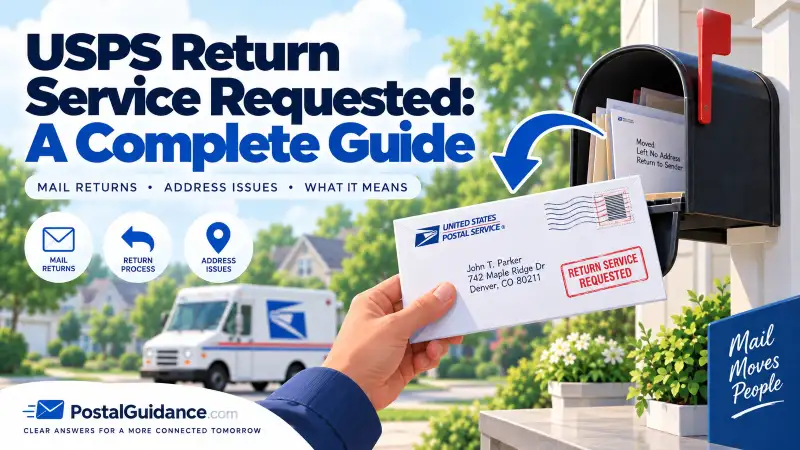
Return Service Requested is a USPS endorsement you print just below the return address that tells USPS to send undeliverable mail back to you, with the reason it could not be delivered or the recipient’s new address, instead of forwarding it or throwing it away. For First-Class Mail and Priority Mail it is included at no extra charge; for USPS Marketing Mail it carries a per-piece fee. Businesses and individuals use it mainly to keep mailing lists accurate and to get important documents back rather than lose them.
Here is exactly what the endorsement does, what it costs, how long a return takes, how it compares to the other USPS address endorsements, and when to use it.
What is Return Service Requested?
Return Service Requested is one of USPS’s ancillary service endorsements, a short instruction printed on the outside of a mailpiece that tells USPS what to do if the item cannot be delivered as addressed. This particular endorsement says: do not forward it and do not discard it, send it back to me, and include why it failed or where the recipient moved.
That makes it a safety net. Instead of an undeliverable letter vanishing into the mail stream, it comes back to you marked with something like undeliverable as addressed or moved, no forwarding address, or with the recipient’s updated address if they filed a change of address. You then know exactly what happened and can fix your records or resend.
How Return Service Requested works
The process is simple once the piece is in the mail:
- You mail the item with Return Service Requested printed clearly, usually directly below the return address.
- USPS attempts delivery as normal. If it is deliverable, the recipient gets it and nothing else happens.
- If it is undeliverable, because the address is wrong, outdated, or the recipient moved without a forwarding order, USPS flags it.
- USPS returns it to you rather than forwarding or disposing of it, attaching either the new forwarding address (if one is on file) or the reason for non-delivery.
- You act on it, updating your mailing list, correcting the address, or resending.
The key behavior that defines this endorsement: the physical piece comes back to you. That is what separates it from endorsements that forward the mail instead (more on those below).
Does Return Service Requested cost anything?
It depends on the mail class:
- First-Class Mail and Priority Mail: the return is included in your original postage, with no additional fee. These classes are returned to sender when undeliverable anyway, and the endorsement adds the address correction or reason at no charge.
- USPS Marketing Mail: this is the important exception. Marketing Mail is not returned by default, so if you want undeliverable pieces back, the endorsement is what requests it, and USPS charges a per-piece fee for each returned item.
So for everyday First-Class letters and invoices, Return Service Requested is effectively free. For bulk marketing campaigns, budget for the return fee, since a large mailing can generate a lot of returns. Whichever class you use, you still pay the normal postage to send the piece, which our guide on how many stamps you need can help you calculate.
How long does a return take?
Return timing depends on the mail class and how far the piece traveled:
| Mail type | Typical return time |
|---|---|
| First-Class Mail / Priority Mail | 5 to 10 business days after the failed delivery |
| USPS Marketing Mail | 2 to 4 weeks (lower priority) |
| Packages | 5 to 15 business days |
| International mail | Several weeks to a few months |
Busy seasons like the December holidays, address-verification steps, and weather can all stretch these windows. International returns take longest because the piece often clears customs in both directions.
The four USPS address endorsements compared
Return Service Requested is one of four endorsements that behave differently, and picking the right one matters. Here is how they compare:
| Endorsement | Forwards to new address? | Returns piece to you? | Gives you the new address? |
|---|---|---|---|
| Return Service Requested | No | Yes | Yes, with the returned piece |
| Forwarding Service Requested | Yes | Only if not forwardable | Via a separate notice |
| Address Service Requested | Yes | Only if undeliverable | Via a separate notice (fee may apply) |
| Change Service Requested | No | No | Via a separate notice only |
In short: choose Return Service Requested when you want the actual mailpiece back in hand, Forwarding Service Requested when you want the recipient to still get it, Address Service Requested when you want it forwarded but also want the new address for your records, and Change Service Requested when you only want the address update and do not need the piece itself.
How to add Return Service Requested to your mail
Adding the endorsement is straightforward, but follow USPS formatting so it is read correctly:
- Print it clearly, ideally in all capital letters, so it is easy for USPS equipment and staff to read.
- Place it just below the return address in the upper-left area of the envelope, which is the standard location USPS looks for it.
- Use a correctly formatted return address, since the whole point is for the piece to come back to you cleanly.
- Apply the correct postage for your mail class, then drop it off or hand it to your carrier as usual.
When should you use it?
Return Service Requested earns its keep whenever the recipient’s address might be wrong and you need to know about it:
- Legal and government documents, where you must be able to prove or retry delivery.
- Invoices and bills, so a moved customer’s returned invoice comes back with their new address for a quick resend.
- Direct mail and customer communications, to clean outdated addresses off your list over time.
It is less useful for casual personal mail, holiday cards, or anything going to an address you have just verified, where the extra endorsement adds nothing. For sending important mail to a PO Box specifically, our guide on sending certified mail to a PO Box covers a related option when you need proof of delivery too.
Frequently asked questions
What does Return Service Requested mean?
It is a USPS endorsement printed below the return address instructing USPS to send undeliverable mail back to you, with the reason for non-delivery or the recipient’s new address, instead of forwarding or discarding it.
Who pays for Return Service Requested?
For First-Class Mail and Priority Mail, the return is included in the original postage at no extra charge. For USPS Marketing Mail, the sender pays a per-piece fee for each item returned, since Marketing Mail is not returned by default.
How long does it take to get mail returned to sender?
First-Class and Priority Mail usually come back within 5 to 10 business days of the failed delivery. Marketing Mail can take 2 to 4 weeks, packages 5 to 15 business days, and international mail several weeks to a few months.
What is the difference between Return Service Requested and Address Service Requested?
Return Service Requested sends the physical piece back to you and does not forward it. Address Service Requested forwards the piece to the recipient’s new address and sends you the updated address separately, sometimes for a fee.
Where do I write Return Service Requested on an envelope?
Print it clearly, in all capital letters, directly below your return address in the upper-left area of the envelope, which is the standard location USPS reads it from.
Is Return Service Requested the same as Return to Sender?
Not quite. Return to Sender is what happens to an undeliverable piece, while Return Service Requested is the endorsement you add in advance that guarantees the piece comes back to you with the reason or new address attached, rather than being forwarded or disposed of.
The bottom line
Return Service Requested is a small endorsement with a big payoff: print it below your return address and any undeliverable mail comes back to you, tagged with why it failed or where the recipient moved. It is free on First-Class and Priority Mail and carries a per-piece fee on Marketing Mail. If your goal is the physical piece back plus accurate address data, it is the right endorsement, and if you only need the new address or want the mail forwarded, one of the other three endorsements fits better.



My certified mail was returned with the code N.O.T., what does this code stand for?
I do not want to guess at that one, because N.O.T. is not one of the standard USPS return endorsements I can verify. The common ones are RTS (return to sender), UTF (unable to forward), NSN (no such number), and REF (refused). Your surest answer is to ask the clerk or postmaster at the office that returned it what that specific mark means, since handwritten or stamped return codes can vary locally.