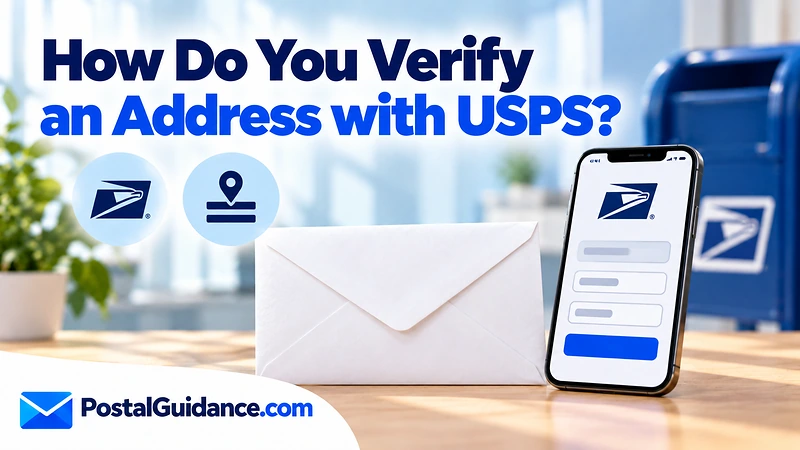
The free USPS ZIP Code Lookup tool is how to verify address with USPS. Enter the street, city and state, and it returns the standardized form of the address along with its ZIP Code. If the tool cannot match what you typed, USPS does not have that exact address on file yet.
That match answers a narrow question. It tells you the address exists in the USPS address file and how USPS writes it. It does not tell you who lives there, whether the home is occupied, or whether a given carrier will deliver a package to the door.
How to verify address with USPS step by step
Here is how to verify address with USPS online. Open the USPS ZIP Code Lookup tool and choose the Find by Address option. USPS lists three lookups on that page: ZIP Code by address, ZIP Codes by city and state, and cities by ZIP Code.
- Pick ZIP Code by Address.
- Type the street address exactly as it appears on your mail or lease.
- Add the apartment, suite or unit number in the unit field if there is one.
- Enter the city and choose the state.
- Submit the form and read the result.
A match returns the address in USPS format and the ZIP Code, and often the ZIP+4 as well. Copy that version into your checkout forms, shipping labels and account profiles. Using the standardized form cuts down on bounced packages and misrouted letters.
How to check address on USPS and read the result
The result page can look like one of three outcomes. Each one means something different, and each has a clear next move.
| What you see | What it means | What to do |
|---|---|---|
| One matching address | The address is in the USPS file and shown in standard form | Use the standardized version on forms and labels |
| Several possible matches | The street number exists at more than one unit or suffix | Add the apartment, suite or unit number and search again |
| No match or not found | The address as typed is not in the USPS file | Check spelling, street suffix, and city name, then contact the local Post Office |
USPS notes that results do not confirm that anyone occupies an address. It also recommends using a recognized city name. A small town or a neighborhood name that is not a postal city can cause a miss even when the street is real.
How to validate address with USPS formatting rules
Many failed lookups come from formatting, not from a missing address, so it helps to know how to validate address with USPS rules in mind. The USPS Publication 28 sets the standard. An address has a recipient line, a delivery address line, and a last line with city, state and ZIP Code.
The delivery line carries the street number, any direction, the street name, the street suffix and the unit. USPS prefers its approved abbreviations for suffixes and unit types, such as APT, STE and UNIT. Put the unit at the end of the delivery line.
If you use a pound sign for the unit, leave a space between the sign and the number. Where the unit type is known, write it out instead of using the pound sign. When the line runs out of room, the secondary information can go on the line directly above the delivery line.
What a not found result usually means
Start with the simple causes. Check the street spelling, the suffix (Street, Avenue, Road), a missing direction such as North or SW, and the unit number. Try the city name that appears on your mail, because the postal city can differ from the name you use for your town.
If the address still does not match, a few situations are likely. New construction or a recently renamed street may not be in the file yet. A rural route, a PO Box or a private road may also use a different delivery address format.
For mail that already lands at the wrong place, the tool is not the fix. See what to do with mail from a former occupant in our guide to previous tenant mail.
New construction and addresses USPS does not have yet
The ZIP Code Lookup tool only reads the existing address file. It cannot add an address. If your home is new, the lookup may fail until the address has been assigned and entered.
USPS publishes no self service form for adding an address. The route is the Post Office that serves the area: contact it by phone or in person and ask what the postmaster needs. Bring the full address, your name, and the paperwork you have.
The same office approves your mailbox. USPS tells homeowners to show the local postmaster their mailbox plans or custom built box for approval, and switching from a curbside box to a wall mounted one also needs the postmaster’s permission. Put the house number on the box, and the full street address if the box sits on a different street from the house.
Addresses for new homes are typically assigned by the local city or county, often through a planning or zoning office. Your builder usually knows who handles it. USPS does not publish a timeline, so ask the Post Office what to expect.
What USPS delivers to your address
People often search for what USPS delivers to my address or which USPS services my address. The lookup tool does not answer that. It shows that the address exists and how it is written.
Delivery type, mailbox location and carrier route are set by the local Post Office. Ask there if you need to know whether you get street delivery, cluster box delivery or a PO Box, and see what time USPS delivers for typical timing.
Packages are a separate question, and some addresses use a locker, as explained in our parcel locker guide. Whether FedEx or UPS delivers to your address depends on each carrier’s own coverage. Check with that carrier, because the USPS tool will not tell you.
To see what is actually coming to your address, sign up for Informed Delivery. It is free, shows grayscale preview images of letter size mail arriving soon plus package status, and works for residential, business and PO Box addresses in eligible ZIP Codes, which USPS says covers most of them. Some apartment buildings without uniquely coded units are not eligible yet.
Keep a copy of the standardized result. Use it every time a site asks for your address, so your billing, shipping and account records all match. Matching records are easier for carriers to sort and for you to correct later.
If your address on file with USPS is wrong
Verifying an address does not change anything on your account. If you moved, file a change of address so mail is forwarded. We walk through that in how to change address with USPS.
If a package is already in transit and needs a new delivery address, use the in transit address change guide instead. A different address on the label can mean a different price.
You can compare rates with the Postage Price Calculator.
If you are not sure which service fits, the Mail Class Selector narrows it down.
Bottom line
Knowing how to verify address with USPS takes a minute and saves returned mail. The tool shows whether USPS recognizes an address and how to write it, but it does not prove anyone lives there or that a carrier will deliver. When the lookup fails on a real home, the Post Office that serves it is the place to ask.