

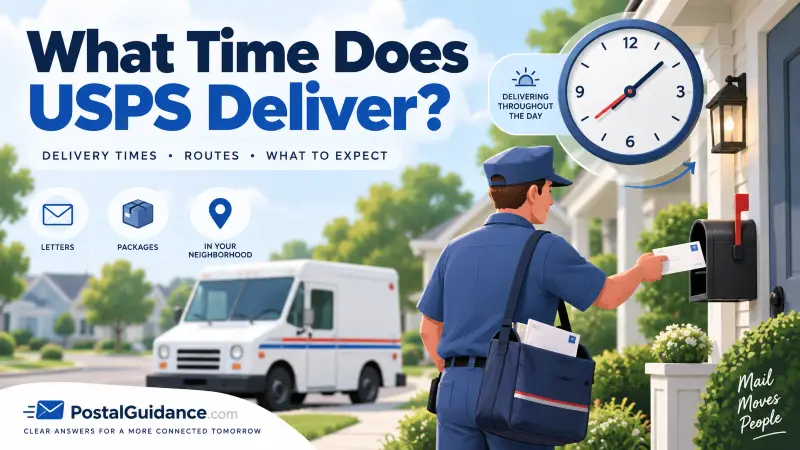
USPS delivers to most homes between 9:00 a.m. and 5:00 p.m., Monday through Saturday. There is no guaranteed time for regular mail, though. Your carrier is out on the route anywhere from about 8 a.m. to 8 p.m., and the exact time your mail lands comes down mostly to one thing: where your address sits on that day’s route.
That is the honest version, and it is worth sitting with for a second, because a lot of the frustration around mail timing comes from expecting a schedule that does not exist. USPS does not hand your carrier a clock with your address on it. It hands them a route and a truck full of mail, and your delivery time is whatever falls out of that on any given day.
So let us get specific. Below I will break down the real delivery window, how it differs for homes and businesses, what makes it shift from one day to the next, how late your mail can realistically show up, and a few ways to work out your own carrier’s rhythm so you can stop guessing.
What time does USPS deliver mail?
For the large majority of homes, mail shows up between 9 a.m. and 5 p.m. Carriers usually clock in early, sort and load their routes, and start delivering between 8 and 9 in the morning. Most people have their mail well before the evening.
USPS gives a wider official window of 8 a.m. to 8 p.m. Do not read that as your expected time. That range is really the full span a carrier might still be working somewhere on their route, not a promise about your mailbox. If you are getting mail at 7 p.m. every single day, that is unusual, and it usually points to a long or short-staffed route rather than the norm.
Here is roughly how it breaks down by where you fall on the route:
| Where you are on the route | Typical delivery time |
|---|---|
| Early stops | 9 a.m. to 11 a.m. |
| Middle of the route | 11 a.m. to 2 p.m. |
| Later stops | 2 p.m. to 5 p.m. |
| Route running behind | 5 p.m. to 8 p.m. |
Do homes, businesses, and PO Boxes get mail at different times?
Yes, and the difference is bigger than most people realize. The delivery window depends a lot on what kind of address you have:
| Address type | Typical timing |
|---|---|
| Residential | 9 a.m. to 5 p.m., varies by route position |
| Business | Often earlier, commonly 10 a.m. to 2 p.m. |
| PO Box | Usually available by mid to late morning, once mail is sorted into boxes |
Businesses tend to see mail earlier because commercial routes are set up separately and run on a tighter schedule, since a company expects its mail during working hours. PO Boxes are different again: your mail is not delivered to a door at all, it is sorted into your box at the Post Office, and it is generally ready for pickup by late morning on the day it arrives. If you rent a box specifically to get mail early, that mid-morning availability is usually the draw.
Why your delivery time changes from day to day
If it feels like your mail comes at a different time every day, you are not imagining it. A handful of things move that number around:
- Where you sit on the route. This is the big one. A carrier delivers in a fixed sequence, so if you are near the start you get mail early, and if you are near the end you wait. It is the main reason two neighbors half a mile apart get their mail hours apart.
- How much mail there is that day. Heavier volume, especially around the holidays or after a Monday backlog, slows the whole route down.
- Who is actually delivering. When your regular carrier is off, a substitute covers the route. They do not know it as well, so it usually runs slower and later.
- Weather. Snow, heat, and storms all stretch a route out.
- Route changes. USPS redraws routes from time to time. If yours got reshaped, your usual time can shift for good.
None of these are things you can control, which is exactly why chasing an exact delivery time is a losing game. The pattern matters far more than the minute.
Does the time change with the season?
It does, and December is the clearest example. From late November through the end of the year, mail and parcel volume spikes to its annual high, and evening deliveries that would be unusual in spring become routine. A 7 p.m. delivery in mid-December is not a red flag; it is the season. Carriers work extended hours through the holidays to clear the volume, and it is completely normal for mail to arrive after dark simply because the sun sets early that time of year. Come January, most routes settle back into their usual daytime rhythm.
How late does USPS deliver?
Officially, carriers can deliver until 8 p.m. In practice, most routes finish well before that, usually by 5 to 6:30 p.m. Evening deliveries do happen, and they get a lot more common in December when volume spikes, or on any day the route is short a carrier.
If it is past 8 p.m. and your mail still has not come, it most likely is not coming that day. I have laid out the full picture of evening and after-dark delivery in a separate guide on how late USPS delivers if you want the deeper version.
Do packages arrive at a different time than letters?
Usually not. In most neighborhoods the same carrier brings your letters and your packages on the same trip, so they land in the same window. There are exceptions. Larger parcels sometimes ride a separate parcel route, and USPS runs Sunday deliveries mainly for Amazon packages and Priority Mail Express, which is why a box can turn up on a Sunday when your regular mail does not.
Weekend timing is its own thing. I have covered it fully in does USPS deliver on Saturday and does USPS deliver on Sunday. And if you are trying to figure out how many days something will take to reach you in the first place, that is a separate question from the time of day, covered in mail delivery time from ZIP to ZIP.
What time does Priority Mail Express arrive?
If you genuinely need a delivery time you can count on, Priority Mail Express is the only USPS service that gives you one. It is guaranteed to arrive by 6 p.m. to most addresses, and to many major-city addresses by 10:30 a.m. or noon. It comes with a money-back guarantee if it misses, delivers in 1 to 2 days, and Sunday and holiday delivery is available in many markets for an extra fee.
Every other service, including Priority Mail, Ground Advantage, and First-Class Mail, gives you a delivery-day estimate but no promise about the time of day. So if the hour truly matters, Express is the one to pay for. To check how many days your route will take before you choose a service, our Delivery Time Estimator gives you a quick read from the two ZIP codes.
What ‘Out for Delivery’ really tells you
When your tracking flips to Out for Delivery, it means your item is loaded on the truck and on the route today. It will arrive sometime within that day’s normal window. What it does not tell you is the hour, so seeing it at 7 a.m. does not mean your package is minutes away, only that it will come at some point before the route wraps up.
Where it gets frustrating is when the day ends and nothing shows up. If that happens, here is what is going on and what to do about it: USPS out for delivery but not delivered.
How to find your carrier’s usual delivery time
You cannot pull an exact time out of USPS, but you can get close by paying attention:
- Sign up for Informed Delivery. This free USPS feature emails you grayscale photos of the letter-mail coming that day, which at least tells you something is on its way and roughly what to expect.
- Watch the pattern for a week. Note the time your mail lands each day. You will usually see a two to three hour band it falls inside, and that band is your realistic expectation, not a single minute.
- Ask your carrier. If you catch them, a quick hello and a question about their usual timing beats any website. They know their route better than anyone.
- Check whether a date is even a delivery day. Around holidays, the free Postal Holiday and Delivery Day Checker tells you at a glance whether USPS is running, so you are not waiting on mail that was never coming that day.
When a late delivery is actually a problem
Mail arriving later than usual on a single day is normal and not worth stressing over. What is worth a closer look is when tracking stops moving for several days, or a package sails past its estimated delivery date with no updates. That is a different situation, and I walk through the causes and fixes in USPS tracking not updating.
Frequently asked questions
What time does USPS stop delivering?
Most carriers finish between 5 and 6:30 p.m., but they are officially allowed to deliver until 8 p.m. Late finishes are most common during the December holidays or when a route is short-staffed.
Does USPS deliver at the same time every day?
No. There is no fixed delivery time for regular mail. Your time shifts with mail volume, whether your regular carrier is working, the weather, and any changes to the route.
What time does USPS deliver packages?
Packages usually arrive in the same 9 a.m. to 5 p.m. window as your letter mail, since the same carrier typically brings both. Amazon packages delivered by USPS on Sundays are the main exception.
What time is mail delivered to a business?
Businesses often get mail earlier than homes, commonly between 10 a.m. and 2 p.m., because commercial routes run on a tighter, separate schedule during working hours.
Can USPS deliver after 8 p.m.?
It is rare. Carriers are meant to wrap up by 8 p.m., though during peak season a badly backed-up route can occasionally run later.
Why is my mail suddenly coming so late?
The usual reasons are a substitute carrier covering your route, higher mail volume, or a route USPS recently redrew. If it stays late for weeks, a route change is the most likely cause.
How can I get mail delivered by a guaranteed time?
Send it Priority Mail Express, which guarantees delivery by 6 p.m. with a money-back guarantee. No other USPS service promises a specific time of day.
The bottom line: stop watching the clock and start watching the pattern. Once you know your route’s usual two to three hour window, USPS timing gets far less mysterious, and you will know right away when something is genuinely off rather than just running a little late.

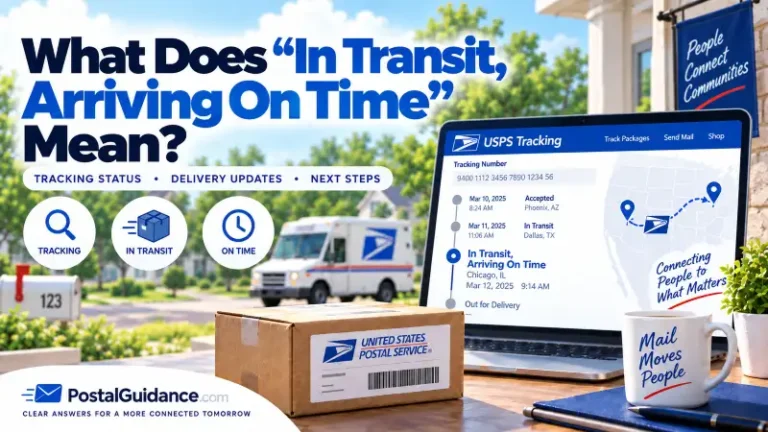
I do not know why it took 6 days to receive a package form Lancaster , Pa to Beaverton Oregon, my tracking nr is 92055903470167300001417475.
According to the tracking records the package was sent to Eugene a 102 miles away by Portland after it was received instead of going to Beaverton and then sent back to Portland to be sent to the correct local post office for distribution.
So, it was on the mail in Pa in May first and received at my address today May 7.
If this is not the place to fill out a complain, kindly, let me know please where.
Thank you,
Anna
That zigzag is normal, if maddening. USPS routes by network and truck schedules, not by the shortest line on a map, so a package can move to a regional hub that is technically farther away before it turns back toward you. Six days coast to coast is within the current range for Ground Advantage or first-class. If it had stopped moving for more than a week you would want to file an inquiry, but this one was just taking the scenic route.
i keep sending certified mailthat does NOT aarrive or arrives LATE……why is this a problem when reg. mail gets there??
Certified Mail actually adds handling. Every certified piece gets extra scans and a signature capture along the way, and it rides with accountable mail rather than the fast automated letter stream, so it can genuinely run a day or two slower than a plain first-class letter. It buys you proof of mailing and delivery, not speed. If a certified piece truly stalls, you can start a Missing Mail search at usps.com/help/missing-mail.htm.