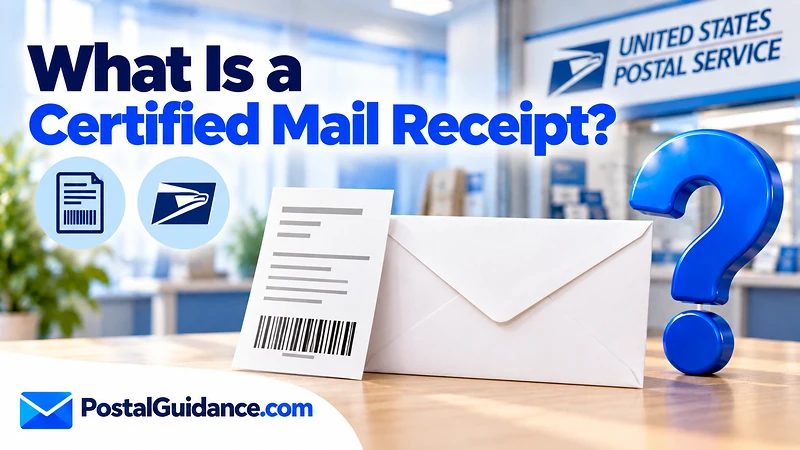
A certified mail receipt is PS Form 3800, the numbered slip USPS gives you at the counter as your proof that you mailed the item. It carries the article number you use to check delivery, and it costs nothing beyond the $5.55 Certified Mail fee. It is not the green card, which is a separate form that proves who signed.
People mix the two up all the time, and the mix up causes real problems in disputes. This guide covers what the receipt shows, what the date stamp means, how to use the number, and what to do if the slip goes missing. For the full service, start with how USPS Certified Mail works.
What the Certified Mail Form 3800 Shows
PS Form 3800 is the receipt for Certified Mail, according to the USPS Certified Mail FAQ. It is a green and white form with a barcoded label and a tear off receipt. The label goes on the front of your envelope, and the receipt is the part you keep.
The receipt has three things that matter. It has the article number, the fee lines, and the Postmark Here box for the date stamp from the Post Office. The article number is the same one printed on the label stuck to your mail.
- The article number, which is your tracking number for this one piece.
- The fees paid: separate lines for the Certified Mail fee, postage and the total, plus checkboxes for return receipt, Restricted Delivery and Adult Signature extras.
- The round date stamp that shows the date and the office where you mailed it.
The receipt does not show the contents of the envelope. It also does not show who signed for it. That proof comes later, from tracking or a return receipt.
The back of the form spells out the mechanics: detach the barcoded portion, affix it to the mailpiece, apply postage and deposit it. It ends with the line Save this receipt for your records, which is USPS’s own advice on retention.
Is the Certified Mail Receipt Postmarked?
Yes, when you mail at the counter. The Domestic Mail Manual tells the sender to attach Form 3800 to the address side of the article and hand it to a USPS employee. The employee then round dates the receipt, which is the postmark that proves the mailing date.
Check the stamp before you leave the counter. A blank or smudged stamp weakens the receipt as evidence. Ask the clerk to restamp it while you are standing there.
The manual also allows another route. You can detach the receipt, mark the date yourself, and mail the piece without a clerk verifying it. A receipt with no clerk stamp proves less in a dispute, so use the counter when the date matters.
When a Printed Shipping Label Replaces the Form
If you print your own shipping label with USPS barcodes, the piece may carry a smaller green Label 3800-N instead of the full form. The manual allows this when a mailer generated label is also on the same piece. The slip you keep still holds the article number and the fee.
Buying online follows the same logic, but the details differ by method. The sibling guide on what USPS actually offers online explains the options.
USPS does not publish a separate electronic version of the 3800 itself. Keep whatever confirmation shows your article number and the payment.
Certified Mail Receipt vs Return Receipt
The receipt and the return receipt answer different questions. The receipt proves you mailed it, and the return receipt proves who accepted it and when. The table compares the three documents using the July 2026 USPS fees.
| Document | Proves | Fee | When you get it |
|---|---|---|---|
| PS Form 3800 receipt | You mailed the item and the date | Included in the $5.55 Certified Mail fee | At the counter, when you mail |
| PS Form 3811 green card | The recipient signed and the delivery date | $4.65 | By mail after delivery |
| Electronic return receipt | The recipient signed and the delivery date | $2.91 | As an electronic record after delivery |
You request either return receipt when you mail. The electronic version is not available to APO, FPO and DPO addresses or certain territories. The full comparison is in the green card versus electronic guide.
Adding a return receipt raises the total, and the combined price breakdown shows the exact figure.
How to Track With the Certified Mail Receipt Number
Use the article number from the receipt on the USPS Tracking page at usps.com. USPS says you can also check status by phone or by a bulk electronic file transfer. The electronic record confirms either delivery or a delivery attempt.
The number is long, so copy every digit from the barcode line. Do not add spaces if the site rejects them.
Tracking can lag a day after you mail, so check again before assuming a problem. Save a PDF of the final delivered status once it appears, because screens change and links expire.
Each status has its own meaning, and the certified mail tracking guide walks through them.
A status that shows a delivery attempt is not a failure on its own. It means a carrier tried and the piece is waiting for pickup. The 15 day hold clock starts from that notice.
How Long to Keep the Receipt
USPS does not publish a fixed retention period for you. The manual says USPS keeps a record of delivery that includes the recipient’s signature, but it does not say for how long. Plan around your own deadline instead.
Keep the receipt for as long as the matter could be disputed. That means the full legal window for a lease notice, a debt letter, a tax filing or a contract.
Store it with a copy of what you mailed and any tracking printout. A phone photo of the receipt is a cheap backup, though the paper original is what a Post Office clerk will ask to see for a 3811-A request.
Some USPS deadlines are short, so act early when something looks wrong.
- A fee refund request goes in 30 to 60 days after mailing, using PS Form 3533 with your mailing evidence.
- Delivery information for a return receipt you paid for but never got must be requested within 90 days of purchase.
What to Do If You Lost the Receipt
Start with the number, because the number is what unlocks the record. Look for it on the carbon copy of your letter, a photo of the label, an email confirmation or a card statement from the Post Office. If you find it, tracking still works as usual.
USPS publishes no process that looks up an article number from your name or address. Ask the Post Office where you mailed the item, and bring any proof of payment. Treat the answer as the clerk’s, not a guaranteed service.
If you paid for a return receipt and it never arrived, there is a defined path. Fill out PS Form 3811-A at a Post Office within 90 days of the purchase date. You must show the original receipt that documents the return receipt fee, so this one needs the paper.
What Certified Mail Receipts Do Not Cover
The receipt is not insurance and it does not guarantee delivery. The form itself states that insurance coverage cannot be purchased with Certified Mail.
Certified Mail is also limited to Priority Mail and First-Class Mail pieces. If the addressee does not claim it, the piece is held at the Post Office for 15 days and returned to the sender on the 16th day.
Registered Mail works differently, including its record keeping. The manual says USPS keeps no permanent mailing record for Certified Mail, unlike Registered Mail. See registered mail versus certified mail if you need that stronger record.
Bottom Line on Your Receipt
Your Form 3800 proves the mailing date and gives you the number for tracking, and nothing more. Get it stamped at the counter, store it safely, and pay for a return receipt when you need proof of the signature. To price the whole mailing, use the postage price calculator.