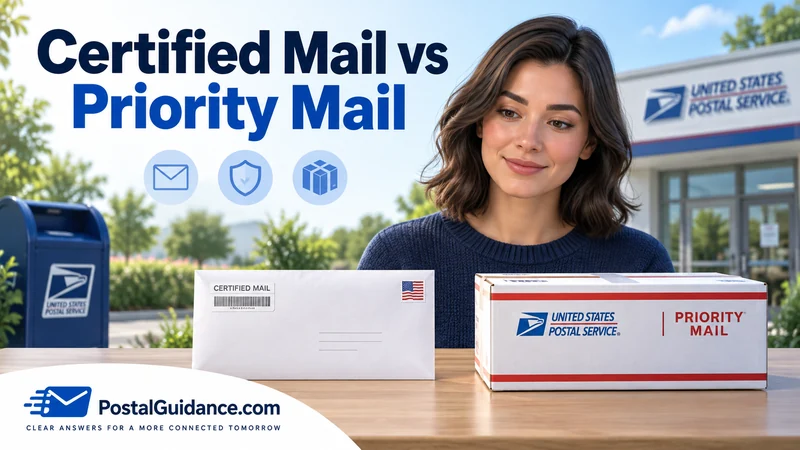
$5.55 buys you a paper trail. $11.00 buys you speed. That is the whole certified mail vs priority mail question in two numbers, and people get it wrong because the two never compete.
Certified mail is an extra service you add to a mailpiece for proof that you sent it. Priority Mail is a mail class you choose because you want the thing to arrive faster.
It only feels confusing because you can combine them. Separate ‘proof’ from ‘speed’ first and the choice gets easy, including the case where you want both.
Holiday prices through January 17, 2027: USPS added a temporary price increase from October 4, 2026 to January 17, 2027 for Priority Mail Express, Priority Mail, USPS Ground Advantage and Parcel Select. During that window, retail Ground Advantage starts at $8.40, Priority Mail at $11.50 and Priority Mail Express at $37.05.
Priority Mail Flat Rate costs $13.90 for the envelope, $14.25 legal, $15.00 padded, $14.65 for the small box, $25.80 medium and $36.10 large ($34.65 APO/FPO/DPO). Priority Mail Express flat rate envelopes are $38.25, $38.55 legal and $39.25 padded. Prices in the rest of this article are the regular July 12, 2026 prices, which return January 18, 2027, and stamps, letters and Media Mail are not affected.
What certified mail actually is
Certified mail is not a shipping speed. It is not a box size either. It is a paper trail.
USPS hands you a mailing receipt when you drop it off. The piece gets scanned as it moves. USPS keeps a delivery record on file, signature included, that you can request later.
You add certified mail to a letter or flat that is already going out as First-Class Mail or Priority Mail. The current certified mail fee is $5.55, on top of whatever postage the letter needs. We break the full itemized cost down in our certified mail pricing guide.
Add return receipt if you want a copy of who actually signed. The mailed version costs $4.65. The electronic version costs $2.91, and both options are covered in our guide to certified mail return receipt.
What certified mail does not do is speed anything up. A certified First-Class letter still moves on the normal First-Class Mail schedule of 1 to 5 business days, timed out in detail in how long certified mail actually takes to arrive.
The certified sticker buys you a record, not a faster truck. For the full rundown on how the service works, see our complete certified mail guide.
What Priority Mail actually is
Priority Mail is a shipping class, the same category as First-Class Mail or Ground Advantage. It moves faster and handles heavier or bulkier items. USPS estimates 2 to 3 days for most shipments.
That window is not backed by a money back guarantee. Retail pricing starts at $11.00 at the counter. Check the current Priority Mail rates and options before you ship.
Every Priority Mail shipment already includes tracking and up to $100 of insurance. Flat rate options exist too, like the $12.90 flat rate envelope. A heavy legal packet does not get penalized on weight the way a First-Class letter would.
Priority Mail on its own gives you tracking scans. It does not give you a postmarked mailing receipt or a signature on file the way certified mail does. The tracking makes it feel like proof, which is where the trouble starts.
Our full breakdown of Priority Mail covers weight limits and box options in more depth than fits here.
What a signature requirement actually changes
Certified mail comes with a signature requirement by default. That sounds minor until the carrier shows up and nobody is home.
Instead of a letter sitting in the mailbox, the carrier leaves a slip and holds the piece at the post office. You or the recipient has to go pick it up or schedule redelivery. That delay can matter when a deadline is close.
Priority Mail without certified added skips that entirely. The carrier can leave it at the door under normal delivery instructions. That is faster in practice even when the tracking timeline looks identical on paper.
If you are mailing to a business address that is staffed during the day, this rarely causes a problem. If you are mailing to a home during work hours, budget extra time for a possible redelivery attempt.
Certified mail vs priority mail: price and speed
| Feature | Certified Mail | Priority Mail | Both Combined |
|---|---|---|---|
| What it is | Extra service (add on) | Mail class | Priority Mail with certified added |
| Typical cost | $0.82 postage + $5.55 fee, about $6.37 | From $11.00 | From $11.00 plus $5.55, about $16.55 |
| Delivery time | 1 to 5 business days | 2 to 3 days, not guaranteed | 2 to 3 days, not guaranteed |
| Mailing receipt with postmark | Yes | No | Yes |
| Delivery record on file | Yes, with signature | Tracking only | Yes, with signature |
| Signature required | Yes, by default | No, unless added | Yes |
| Insurance included | No | Up to $100 | Up to $100 |
Yes, you can combine certified mail and Priority Mail
This is the part most guides skip. Certified mail is not locked to First-Class Mail. USPS lets you attach the certified mail extra service to a Priority Mail shipment.
You keep the mailing receipt and the delivery record. You also get the faster 2 to 3 day window. Check the details on the certified mail extra service page before you go to the counter.
The math is simple. Take Priority Mail postage and add the $5.55 certified fee. A flat rate envelope with certified mail added runs about $18.45 total.
That is not cheap for a single document. It does end the certified mail vs priority mail tradeoff, though, instead of forcing you to pick one side.
Ask for it by name at the counter: certified mail on a Priority Mail piece. Clerks add the certified sticker and receipt the same way they would on a First-Class letter. It gets tied to the Priority Mail tracking number instead.
When certified mail alone is the right call
Certified mail earns its cost when the document is small and light. The thing that matters is proving you sent it by a deadline, not how fast it arrives. Legal notices, IRS correspondence, lease terminations, and formal demand letters all fall here.
Federal tax law treats the certified mail postmark date as your filing date under the mailbox rule. That holds even if the IRS receives the piece days later. That single fact is why accountants default to certified mail for anything with a filing deadline.
Speed does not matter much if the postmark already protects you. For a court filing or an IRS response, certified mail with return receipt is usually the safer default over Priority Mail alone.
The signed receipt is documentation a tracking scan cannot fully replace. If a dispute ever comes up, that piece of paper is what you want in hand.
When Priority Mail alone is the right call
Priority Mail wins when the package has weight, bulk, or a real time pressure. Proof of mailing is not the point here. Shipping a product to a customer or moving a heavier packet of documents both favor Priority Mail.
The included $100 insurance and free tracking already cover most sellers’ needs. If a buyer disputes delivery, USPS tracking history plus the built in insurance is usually enough to resolve it.
Do not pay for certified mail on a routine package sale. It adds cost and a signature requirement that can annoy a buyer who wants their item left at the door. If you need next day speed instead, that is a job for Priority Mail Express, not certified mail.
Stronger proof than either one alone
Certified mail gets you a signature from whoever is at the address. It does not confirm that the specific person you needed to sign actually signed.
Restricted Delivery adds that layer for $14.35. It limits delivery to the named addressee or their authorized agent, which matters for a court summons or a legal notice tied to one specific person.
Adult Signature adds a different guarantee for $9.70. It requires the signer to be 21 or older and to show ID, which shows up more on age restricted shipments than on legal mail.
Most certified mail vs priority mail decisions do not need either extra layer. Reach for Restricted Delivery when the identity of the signer, not just a signature, is what the mailing depends on.
The tax season mistake
Tax filers ask a version of this question every spring: can Priority Mail with tracking replace certified mail for a return or a form with a deadline. Forum threads on this exact question show a split.
Some filers say Priority Mail tracking was accepted without issue. Others got pushback later because tracking alone did not satisfy the mailbox rule the way a certified mail receipt does.
Here is the gap. Tracking shows movement and a delivery scan, nothing more.
A certified mail receipt shows that you mailed a specific piece on a specific date, stamped by a clerk at a counter. That is the standard courts and agencies were built around.
If it were me, I would treat forum success stories about plain Priority Mail as luck. If the outcome of a mailing could end up in front of a judge, an IRS agent, or a landlord’s lawyer, add certified mail even if it costs more. Below that line, Priority Mail tracking is plenty.
Quick decision guide
- Sending a lease notice, demand letter, or IRS response with no rush: certified mail alone, about $6.37.
- Sending the same document but the deadline is close: certified mail on a Priority Mail shipment, about $16.55.
- Shipping a product or a heavier packet with no legal deadline: Priority Mail alone, from $11.00.
- Need it there in 1 to 2 days with a guarantee: Priority Mail Express, not certified mail.
- Need to prove one specific person signed: add Restricted Delivery to certified mail.
Bottom line
Certified mail vs priority mail is not really a contest, because they solve different problems. Certified mail proves you sent something. Priority Mail gets something there faster, with insurance built in.
Pick certified mail alone for slow, low stakes proof. Pick Priority Mail alone for speed and packages.
Combine them when the deadline and the paper trail both matter. Legal and tax mail tends to create exactly that situation.
Run the exact cost for your envelope or box through the postage price calculator before you head to the counter, since weight and zone both move the final number. Still weighing which class fits your mailpiece at all? Our mail class selector can narrow that down first.