Certified mail does not require a special envelope. That surprises a lot of first time filers who search for a certified mail envelope expecting one exact product they are supposed to buy. There is no such product, at least not from USPS.
You can use almost any envelope you already own. It has to meet the same size rules as every other USPS letter or flat. That is the whole requirement.
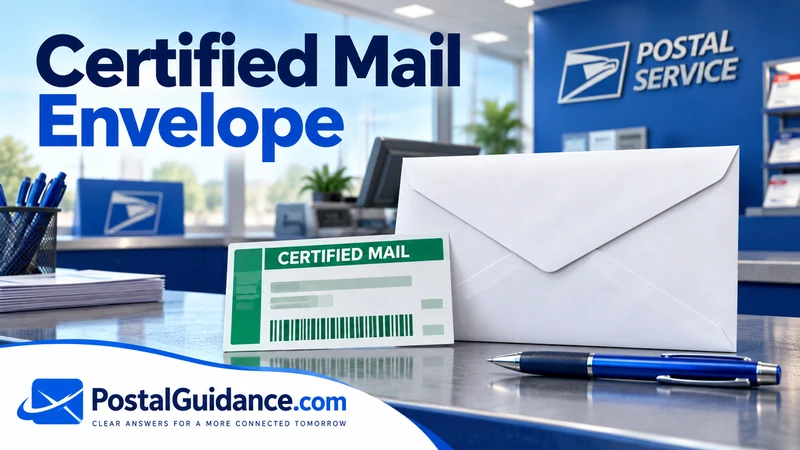
What turns a plain letter into certified mail is not the envelope. It is PS Form 3800, the green and white barcoded sticker.
I have seen people hunt around for the one true certified envelope when the clerk only needed a plain one and a sticker. Here is what you need, where the sticker goes, and when a prepaid option is worth the money.
What actually makes an envelope a certified mail envelope
Nothing about the envelope itself is special. What makes a mailpiece certified mail is PS Form 3800, the barcoded green and white label. That label carries the tracking number.
It is what the clerk scans at the counter. It is also what USPS scans again at delivery. Every step of the certified mail tracking history runs off that one barcode, not the envelope brand.
If you want a return receipt, the green card, fill out PS Form 3811 too. Attach it to the back of the envelope. That card costs $4.65, or $2.91 for the electronic version, on top of the $5.55 certified mail fee.
Any envelope, plus PS Form 3800, plus your regular First-Class Mail or Priority Mail postage, equals certified mail. Those are the only two classes USPS pairs it with. No envelope sold anywhere is required by USPS rules.
Where the certified mail sticker goes on the envelope
This part is governed by an official rule, and most guides skip it. Section 503 of the Domestic Mail Manual says mailers must place the certified mail label above the delivery address. It also has to sit to the right of the return address.
That is not a suggestion. Clerks check for it. A misplaced sticker is one of the small reasons a piece gets kicked back at the counter.
In practice your envelope front needs three clear zones. Your return address goes top left. The barcoded sticker goes top right, and the recipient address sits centered below both.
If your envelope is too small or too cluttered to fit all three, you picked the wrong size. You did not pick the wrong brand of envelope. You can confirm the exact placement language on the USPS Domestic Mail Manual page for Certified Mail.
What size envelope works for certified mail
There is no certified mail specific size limit. Your envelope just needs to fall inside USPS standard letter or flat dimensions. Go outside those and you either get bounced back or hit with a nonmachinable surcharge.
| Mailpiece type | Minimum size | Maximum size | Thickness |
|---|---|---|---|
| Letter (standard envelope) | 5 by 3.5 inches | 11.5 by 6.125 inches | Up to 0.25 inch |
| Flat (large envelope) | 5 by 3.5 inches | 15 by 12 inches | Up to 0.75 inch |
A standard number 10 envelope, the everyday business size, fits inside the letter limits easily. There is room to spare for the sticker layout above. If you are mailing a contract or a stack of pages, jump to a 6×9 or 9×12 flat instead.
A letter also maxes out at 3.5 ounces, which is roughly 20 sheets of standard paper. A stuffed, lumpy letter envelope is exactly the kind of thing that trips the $0.49 nonmachinable surcharge. Size up rather than force it into a number 10.
Do you need a window envelope for certified mail
You do not need a window envelope. A plain envelope with the address typed or handwritten in the right spot works fine. What a window buys you is convenience, nothing more.
You print the recipient address once on the letter itself. Fold it so the address shows through the window. You skip retyping it on the outside.
Several vendors sell certified mail envelopes with a second window cut sized for the PS Form 3800 sticker. The label shows through without any taping. That is a real time saver if you send certified mail often, but it is a convenience, not a USPS requirement.
Prepaid and preprinted certified mail envelopes
Search ‘certified mail envelope’ and you will find companies selling preprinted, sometimes windowed envelopes built for this exact purpose. Simple Certified Mail offers windowed number 10, 6×9, and 9×12 envelopes to its customers, and CertifiedMailLabels.com sells windowed number 10 envelopes. Each has a Certified Mail banner printed on front and a die cut window for the barcode label.
Stamps.com sells a similar number 10 product built to pair with labels printed from its own postage software. None of these are official USPS products. Using one is never required to send certified mail.
What they save you is layout work. You get the return address, delivery address, and sticker positioned correctly every time without measuring by hand. If you send certified mail a handful of times a year, honestly, a plain envelope is fine.
If your job involves certified mail weekly, a preprinted style pays for itself in saved time. That is a different call from choosing between certified mail and other extra services. That choice comes down to what proof you need, not the envelope.
What to bring to the post office counter
You do not need to buy anything special beforehand. Bring your envelope, addressed and sealed except for the postage. The clerk hands you a PS Form 3800 and helps you fill it out if needed.
They attach the label, weigh the envelope, and add the $5.55 certified mail fee to the postage. Add the return receipt fee on top if you want the green card. You can read the full walkthrough in our guide to how to send certified mail step by step.
If you print certified mail labels at home, you can skip the counter entirely. Just make sure the barcoded label is affixed and postage is applied first. Sites that offer certified mail from your printer instead of the counter work the same way, minus the trip.
The one thing you lose printing at home is a hand postmark. Some senders want that extra proof for legal deadlines. If that matters for your situation, take the sealed envelope to the counter instead of a collection box.
When a plain envelope is not enough
Stick with a plain letter envelope for a normal one to five page letter. Move up to a flat once your stack gets thick enough to bulge or heavy enough to pass 3.5 ounces. Also size up for anything with a clasp, string, or rigid backing board, since those trigger the surcharge on a letter size piece.
Sending something that needs to survive rough handling, like a legal notice or tax documents? If it were me, I would skip the flimsy envelope and use a sturdier paper stock or a rigid mailer, and eat the flat postage. Check our certified mail cost breakdown before you decide, since a flat costs more in postage than a letter even with the same certified mail fee.
Mailing to a PO box changes nothing about the envelope itself. It does change how delivery works on the other end, which we cover separately in our guide to sending certified mail to a PO box.
And if a signature at delivery is the whole point of your certified mail, rather than the tracking, read our piece on whether certified mail always requires a signature. It is a separate question from which envelope to use.
Bottom line
A certified mail envelope is just a regular envelope that meets standard USPS size limits. It has to carry PS Form 3800 in the correct spot, above the delivery address and to the right of the return address. Windowed and preprinted versions exist to save you time, and USPS does not require them.
Pick the size that fits what you are sending. Letter for a few pages, flat for anything bulkier. Before you head to the counter, run the numbers through our postage price calculator so you know the total cost ahead of time.