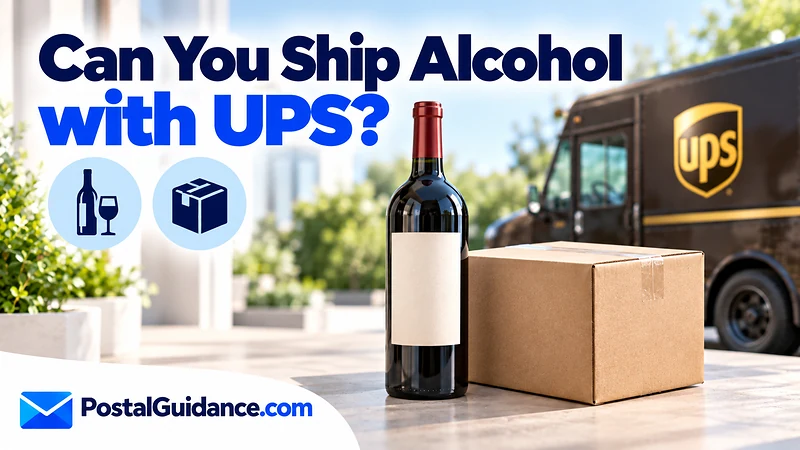
Can you ship alcohol via UPS? Not as a private person. UPS takes wine, beer and spirits only from licensed businesses that signed a UPS alcohol agreement.
The rule is about who ships, not about the drink. A winery, brewery, distillery or licensed retailer can ship to adults in approved states. Everyone else needs another route, and this guide covers what UPS allows, what the recipient must do, and what to try instead.
Can you ship alcohol via UPS without a license?
UPS is direct about it. It does not accept alcohol from shippers who have not signed the matching agreement. That applies to wine, beer and spirits alike.
The agreements are built for businesses that hold the right license. A gift bottle does not qualify. Neither does a case you are moving to a new home, even if the person receiving it is an adult.
The shipper also carries the legal burden. UPS makes the shipper responsible for the laws of both the origin state and the destination state. A private sender has no agreement, no license and no way to meet that duty.
That is why the answer to can you ship alcohol via UPS is no for individuals.
What UPS requires for wine, beer and spirits
UPS runs a separate agreement for each category. The wine, beer and spirits rules differ on who may ship, but the core terms match. The UPS wine page has the fullest detail.
| Drink | Agreement named by UPS | Who can ship |
|---|---|---|
| Wine | UPS Agreement for Approved Wine Shippers, or the Wine Industry Fulfillment House Agreement | Licensed wineries, retailers and fulfillment houses |
| Beer | UPS Agreement for Approved Beer Shippers | Approved licensed beer shippers |
| Spirits | UPS Agreement for Approved Spirits Shippers | Licensed shippers, with direct to consumer limited to distilleries |
Every shipment must use Delivery Confirmation Adult Signature Required. The person signing must be 21 or older.
Spirits have the narrowest door. The UPS spirits page limits direct to consumer shipping to distilleries, with age verification, and says quantity and frequency limits depend on the state.
Which shipment types UPS allows
The agreements list the kinds of shipment that are permitted. A business has to fit one of them and meet the law in both states.
- Licensed to licensed: a business to business shipment between two authorized parties.
- Winery direct: a winery ships to a consumer who bought on site, or who orders by mail or internet in a permitted state.
- Retailer direct: a licensed retailer ships to a consumer in an approved state.
- Intrastate retailer: a retailer ships to a consumer inside its own state, in states that allow it.
- Distillery direct: a distillery ships spirits to a consumer with age verification, depending on state law.
Beer follows the same pattern. UPS says direct to consumer beer shipping is available only where state law allows it.
Wine, beer and liquor one by one
Readers usually ask about one drink at a time, so here is the short version of each.
- Wine: the most open category. Wineries, retailers and fulfillment houses can ship if they hold the agreement and the destination state allows it.
- Beer: only approved licensed shippers can send it. Delivery goes to an adult who is 21 or older and shows photo ID.
- Liquor: the tightest category. A private person cannot ship it, and only distilleries can ship direct to a consumer.
None of the pages list a small quantity exemption. A single bottle follows the same rules as a case, so a one bottle gift does not change the answer on whether you can ship alcohol via UPS.
The same logic covers every way of asking. You cannot send, mail or ship alcohol through UPS as an individual, whether the box holds one bottle or twelve.
Packing and labeling rules
UPS also controls how the bottles are packed. UPS accepts inner packaging of molded expanded polystyrene foam, a folded corrugated tray or a molded fiber tray. That goes inside a sturdy outer corrugated box.
Each bottle must be secured in the center of the package, away from the walls. This protects the glass and keeps a leak from reaching the outside of the box.
Domestic packages also need UPS’s alcoholic beverage shipping label. Shippers order it by calling 1-800-742-5877 and asking for item 01990336, which comes 150 labels to a pack. The label tells the driver to collect an adult signature, so it is not optional.
The law behind the UPS rule
UPS did not invent these limits. The federal Webb Kenyon Act, which the Alcohol and Tobacco Tax and Trade Bureau administers, prohibits shipping alcohol into a state in violation of that state’s law. The bureau explains this on its direct shipping page.
States hold the main enforcement role. Congress gave them extra tools in 2000 through the 21st Amendment Enforcement Act, because states are better placed to defend their own laws.
Businesses that ship directly also need federal basic permits. The bureau warns that those permits can be at risk if a business breaks state rules. That is why a carrier wants a signed agreement from every alcohol shipper, and why it will not take a bottle from a stranger.
Which states can receive alcohol
UPS does not publish one simple state list on its public pages. Approved states appear in Addendum A of the agreement, which a shipper receives when it signs up.
State law adds more limits. UPS notes that origin and destination states can set quantity caps, reporting duties and frequency limits. Some states block outside shippers entirely.
Laws also change. UPS’s spirits page says that, effective August 27, 2026, Michigan allows intrastate direct to consumer alcohol shipments. A licensed shipper has to check each destination before sending.
What happens if someone tries anyway
UPS does not accept alcohol from shippers without the agreement, so a hidden bottle breaks its terms. The carrier does not publish a penalty schedule for this on the pages above.
The bigger risk is legal. State law governs what can enter, and the federal Webb Kenyon Act backs it up. A sender who mails alcohol into a state that bans it can face state action, and the package may never arrive.
If you are unsure, do not ship it. The safe answer to whether you can ship alcohol via UPS is to let a licensed seller do it.
What the recipient has to do
Adult signature delivery means someone must be home. The driver checks that the signer is 21 or older, and the package cannot just be left at the door.
If no adult is available, the package can be held for pickup. UPS says wine can wait at a UPS Customer Center or at an Access Point that accepts restricted articles.
The recipient must show a government issued photo ID. Our guide to the UPS Access Point explains how pickup works.
Can a UPS Store ship alcohol for you?
The store name is similar, so people assume the answer is yes. The UPS pages above describe agreements with licensed shippers only, and The UPS Store does not publish a consumer alcohol shipping service. A store counter cannot sign the agreement on your behalf.
Franchise locations also set some policies of their own. Call the specific store before you plan around it, and expect that a private bottle will be turned away. Our guide covers when the UPS Store closes.
How a business can start shipping alcohol with UPS
A licensed business has to do the paperwork first. It holds the right state and federal license, signs the UPS agreement for its drink, and checks Addendum A for its destination states.
It then packs to the UPS standard, applies the alcoholic beverage label and books Adult Signature Required on every package. The shipper also has to follow any quantity, reporting or frequency rules in the origin and destination states.
Fulfillment houses can do this on behalf of small wineries. UPS has a separate Wine Industry Fulfillment House Agreement for them. A small producer without its own agreement can sometimes ship through one.
Common situations and what to do
| Your situation | What to do |
|---|---|
| Gift for a friend in another state | Order from a winery, distillery or retailer that ships there under its own agreement |
| Moving with a home collection | Drive it yourself or ask a licensed mover about its rules |
| You own a winery, brewery or distillery | Sign the matching UPS agreement and confirm your license covers each destination |
| You own a shop | Check state retailer shipping law first, then apply for the retailer agreement |
| Empty bottles or non alcohol drinks | These are not alcohol shipments, so normal packing rules apply |
An empty bottle is not the same as a full one. Pack it as breakable glass and follow the steps in our guide on how to ship a package with UPS.
Better ways to get alcohol to someone
You do not need to ship the bottle yourself. Each option below keeps a licensed party in charge.
| Option | How it works | Watch for |
|---|---|---|
| Order from a winery or distillery | The producer ships under its own UPS agreement | Destination state must allow it |
| Order from a licensed retailer | The shop ships the gift to the recipient | Retailer must offer shipping to that state |
| Buy in the recipient’s state | Order local delivery or a gift card from a store there | Local delivery rules and age checks |
| Carry it yourself | Bring the bottle in a car or checked bag | State and airline rules |
If you are comparing carriers for an item that is allowed, the shipping cost comparison tool shows prices side by side.
For timing on a gift, try the delivery time estimator before you choose a service.
The bottom line on UPS and alcohol
So, can you ship alcohol via UPS? UPS does carry alcohol, but only for licensed businesses with a signed agreement, and only to adults who sign at delivery. If you are a private person, buy through a producer or retailer that already has that agreement.