$100. That is how much usps priority mail insurance every Priority Mail label carries before you pay a dime extra. A surprising share of sellers have never heard that number.
You do not add it at the counter. It is baked into the label price.
The catch is how small $100 feels once a $400 item goes missing. Most people learn that only after it breaks.
You will still see $50 on older blog posts and even some outdated USPS pages. That figure is a leftover from an earlier rate era.
Retail and commercial Priority Mail both include up to $100 today. The rule sits in the Domestic Mail Manual, section 503, and I checked it this week.
What usps priority mail insurance actually covers
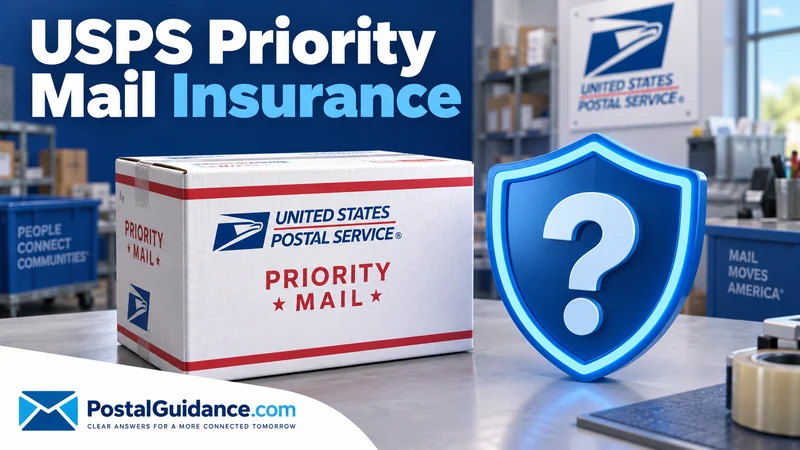
When you pay for Priority Mail at retail price or through commercial postage, USPS automatically insures the contents. Coverage goes up to $100. No form, no extra line item, no separate receipt.
It applies to the merchandise inside the box. The only condition is a valid USPS barcode. Every label from the counter or Click-N-Ship already has one.
Priority Mail Express carries the same baseline. That is $100 for merchandise, and up to $100 per piece for nonnegotiable documents.
If your package is worth less than $100, you are already covered. You do not need to buy anything else.
The part people miss is that $100 is a ceiling, not a floor you build on for free. Ship a $300 item in a Priority Mail box and pay nothing extra. You are only ever getting $100 back if it disappears.
How to buy more coverage
You can add insurance on top of the included $100. USPS covers declared value up to $5,000 for most Priority Mail and Ground Advantage shipments. You can buy it at the retail counter, through Click-N-Ship, or through third party postage software.
The fee scales with the declared value. The exact bands live in Notice 123, the official USPS price list, which updates whenever rates change.
If it were me shipping anything worth more than the free $100, I would price the extra coverage before printing the label. It usually runs a few dollars. Eating a $300 loss to save $5 is a bad trade.
Check the current fee for your declared value on the shipping screen, or ask the clerk. I could not pull the fee table from a live USPS page this session, so I will not guess a number here.
Want to see how insurance changes the total before you commit? Our postage price calculator compares the base label price against what extra coverage adds.
What is not covered
This is where a lot of claims fall apart, and it is the part most guides skip. USPS will not pay a claim for something that was prohibited or restricted to begin with. The exclusions live in DMM section 609.
Fragile items that could not survive normal handling are excluded, packaging or not. So is perishable content that spoiled, melted, or froze in transit.
Cash, negotiable items, and bullion are capped at a $15 payout. That cap applies no matter what you declare, and it does not apply to Registered Mail.
Packaging matters more than people expect. If the contents arrive broken and the outer box shows no damage, USPS can deny the claim. Their argument: the contents were not protected well enough for normal handling.
Consequential loss is never covered either. That means your time, a canceled sale, or a missed deadline do not count. Only the actual value of the item does.
Proof of value: what you actually need
Do not wait until something goes missing to gather this. USPS wants documentation showing what you paid or what the item is worth.
A sales receipt works. So does a paid invoice or a credit card statement showing the purchase. A dated online transaction record works too, as long as it shows buyer, seller, price, and item.
For collectibles or anything without a clean receipt, get a written statement of value from a licensed dealer. Resellers who cannot produce a receipt for every item should screenshot the listing and sale price before shipping.
Keep that folder of receipts somewhere you can find it fast. A claim with proof attached moves through review far quicker than one you are rebuilding weeks after the fact.
Claim windows, in brief
Timing depends on what happened. For a lost package, you wait 7 days after mailing on Priority Mail Express. Standard Priority Mail makes you wait 15 days.
Damaged contents or missing pieces let you file right away. Every claim still has to go in within 60 days of the mailing date. USPS says decisions usually come back in 5 to 10 days, with payment 7 to 10 business days after approval.
A denial gets a 30 day window for a first appeal, then 30 more days for a final one. For the forms and uploads step by step, our guide to filing a USPS claim covers the whole process.
| Service | Included coverage | Max additional coverage | Notes |
|---|---|---|---|
| Priority Mail (retail/commercial) | $100 | Up to $5,000 | Requires proper barcode and retail or commercial pricing |
| Priority Mail Express | $100 merchandise, $100 per document | Up to $5,000 | Delivery guarantee applies separately from insurance |
| Ground Advantage | $100 | Up to $5,000 | Same barcode and pricing rule as Priority Mail |
| Registered Mail | Varies by declared value | Up to $50,000 | Best option once one item passes $5,000 |
Registered Mail for high value shipments
Once you ship something worth more than $5,000, Priority Mail insurance stops being the right tool. Registered Mail is built for that tier.
Coverage runs up to $50,000, and the item gets signed for at every handoff. It moves slower than Priority Mail. For jewelry or anything with real cash value, I would take that tradeoff every time.
Real denial patterns worth knowing
Most usps priority mail insurance claims that get denied fail for a handful of repeat causes. Missing proof of value is the most common one.
Packaging disputes come next, where USPS argues the box could not have handled normal transit. Filing too early or too late trips people up too. The waiting windows and the 60 day deadline are both firm.
One more pattern. Your tracking says delivered but the package never showed up, which runs on a slightly different path than a straightforward loss in transit.
It still falls under the same insurance. The documentation and timing shift a bit, so treat it as its own situation.
Bottom line
usps priority mail insurance gives you $100 automatically on every Priority Mail shipment. You can buy up to $5,000 more when the contents are worth it.
Keep your receipts and pack like the box will get dropped, because it will. Price out extra coverage before you print the label, not after the tracking goes quiet.
Still deciding between services? Our breakdown of what Priority Mail actually includes and our look at what Priority Mail costs at the counter are both good next stops.