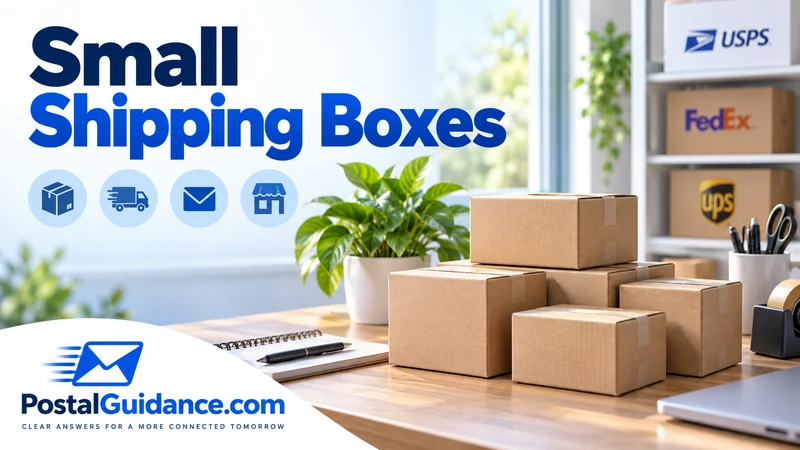
A box that is two sizes too big is the single most common packing mistake small sellers make. It wastes cushioning material. It can also quietly raise your shipping cost through dimensional weight pricing.
Small shipping boxes solve that problem for anything that does not need a full size carton. Jewelry, phone cases, small electronics, and single garments all ship better in a box built for their actual footprint.
Here is how small shipping boxes break down by size. This also covers where to buy them and how to dodge the dimensional weight trap that catches so many sellers.
What counts as a small shipping box
Most carriers and suppliers treat anything under roughly 12 inches on its longest side as a small box. A few common sizes cover the bulk of what small sellers actually ship.
| Size | Typical dimensions | Good fit for |
|---|---|---|
| Extra small | 6x4x4 in to 8x6x4 in | Jewelry, small cosmetics, phone accessories |
| Small | 9x6x4 in to 10x8x6 in | Books, small electronics, single garments |
| Small cube | 8x8x8 in to 10x10x10 in | Mugs, candles, small kitchen items |
Our full shipping box size guide covers the complete range through large and extra large cartons. This article stays focused on the small end of that lineup.
Buying small shipping boxes in small quantities
Sellers who ship occasionally rarely want a case of 100 identical boxes taking up closet space. Walmart, Office Depot, and most home improvement stores sell small boxes individually or in packs of 10 to 25.
Dollar stores and discount chains sometimes carry small boxes too, though sizing is inconsistent visit to visit. Sellers on eBay’s own community forum describe a simpler approach: stock a handful of core sizes instead of guessing at every dimension.
That avoids both the storage problem and the cost of ordering more than a slow month needs. A local shipping store can also sell single boxes at a markup, useful for a one off shipment.
Buying small shipping boxes in bulk
Once volume climbs past a few packages a week, bulk pricing starts to matter more than convenience. Uline, Grainger, and similar wholesale suppliers sell small boxes by the case at a lower cost per unit.
A seller shipping daily typically saves the most by standardizing on two or three small sizes. Ordering a few hundred at a time keeps unit cost down without the storage burden of case after case in a size nobody uses.
Compare a wholesale case price against your actual monthly box use before committing. Buying too far ahead just moves the storage problem from your shelf to your garage.
Free small box options, and the catch that comes with them
USPS gives away its own small Priority Mail boxes at no charge. That includes the Small Flat Rate Box and the smaller side loading Priority Mail Small Box.
Our full breakdown of the free Priority box catalog covers ordering and stock limits in detail. The catch applies to every free USPS box without exception.
That packaging can only ship using Priority Mail postage. USPS enforces the rule through automated scanning at its sorting facilities.
A free small box shipped under a cheaper service gets flagged and charged the correct rate. Our dedicated look at the Small Flat Rate Box specifically covers its exact price and when it beats paying by weight.
USPS lists current stock and pack sizes on its own free shipping supplies catalog.
Small box versus mailer: when a box is not the right call
A padded or poly mailer beats a small box for anything soft, flat, or genuinely light. Clothing, paperback books, and documents rarely need the rigid protection a corrugated box provides.
A box earns its place once an item has real structure worth protecting. Electronics, ceramics, and anything with sharp corners that could puncture a mailer all belong in a box even at a small size.
Sellers on packaging forums lean toward the box whenever a customer would be upset to receive an item damaged. The extra cost of a small box over a mailer is usually just a few cents.
Right sizing to avoid dimensional weight charges
Dimensional weight pricing charges by a box’s volume instead of its actual weight, whenever that number comes out higher. A lightweight item in an oversized box can cost more to ship than the same item packed tightly.
Carriers calculate this by multiplying length, width, and height. They then divide by a set divisor that varies by carrier and service.
A box with two or three inches of dead air on every side inflates that number fast. Run a size check against dimensional weight to see exactly where a box and weight combination lands before you ship it.
Running the numbers before you seal the box beats finding out after the label already printed.
Practical sizing tips from real sellers
Measure the item first, then pick the smallest box that closes without bulging or forcing it shut. Going up a size to feel safe almost always costs more than the risk was ever worth.
Keep two or three core small sizes on hand instead of stocking every possible dimension. Most small item shipments fit comfortably into a narrow handful of standard sizes anyway.
Leave just enough room for a thin layer of cushioning. Skip the full inch of empty space on every side, since that space is what drives dimensional weight up.
The bottom line
Small shipping boxes exist to match packaging to items that do not need a full size carton. That saves both cushioning material and shipping cost, and the right size beats the biggest box in the closet almost every time.
Buy in small quantities while volume stays low, then shift to bulk pricing once shipping becomes routine. Check free USPS options first, and always weigh dimensional pricing before defaulting to whatever box happens to be on hand.