
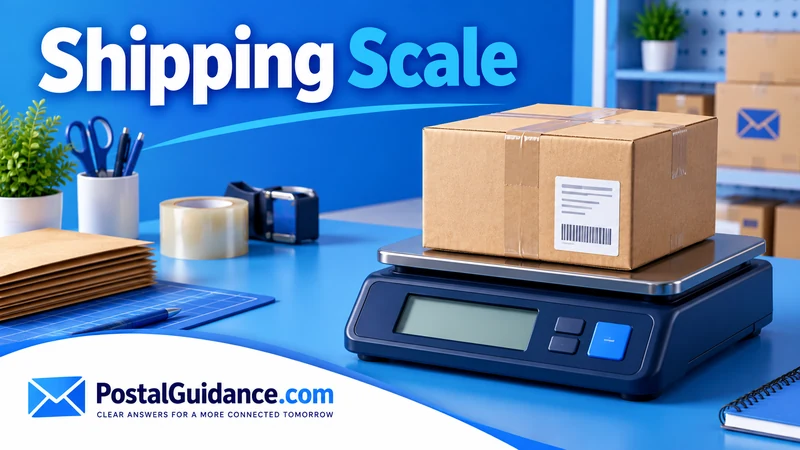
You eyeball the padded envelope. You set it on a scale that rounds to whole ounces. It reads 4, so you print a 4 ounce label.
Ten days later the package limps back with a postage due sticker. It actually weighed 4.3 ounces, and USPS billed the extra ounce.
A cheap shipping scale did that, not bad luck.
The scale is the one tool in a home shipping setup that directly decides what you pay. Get the resolution wrong and you either overpay on every label or underpay and eat a penalty later. Neither is small money once you ship more than a handful of packages a week.
Resolution matters more than the number on the box
Every scale advertises a maximum capacity. That big number gets all the attention on the listing. Honestly, it is the least useful spec on there.
Resolution is the smallest step the scale can display, and it decides whether your postage is right. A scale that reads in whole ounces cannot tell a 3.4 ounce envelope from a 3.9 ounce one. Both show up as 4.
For letters and flats, where postage jumps in ounce steps, that rounding is the whole ballgame. Above a pound the stakes drop. Carriers bill boxes in pound brackets, so a stray tenth of an ounce rarely moves the price.
0.1 ounce for letters and flats, 1 ounce is fine above a pound
If you send First-Class letters or large envelopes with any regularity, buy a shipping scale with 0.1 ounce resolution. Look for one rated at least 1 to 5 pounds. Buying for capacity and forgetting resolution is the mistake I see most often.
Here is why a tenth of an ounce matters. A First-Class letter gets the base price up to 1 ounce. USPS then adds a fee for every ounce, or any fraction of one, after that.
A letter at 1.02 ounces is a 2 ounce letter, full stop. A whole ounce scale reads 1.02 as 1 and tells you a single stamp is fine. It is not.
Check the current per ounce math with the site’s postage price calculator before you commit to a stamp count. Or check how many stamps a given weight actually needs if you would rather skip the math.
Once a piece clears a pound, the brackets get wider. Ground Advantage and Priority Mail both price in whole pound steps past that point. A scale that reads to the nearest ounce is accurate enough for boxes.
What an under reading actually costs you
Carriers do not split the difference on weight. USPS rounds a package up to the next bracket when it bills a shipment, never down. A scale that reads light hides that line from you.
Two things can happen when postage is short. A clerk or a carrier’s scanner catches a letter, and it gets marked postage due. Then it is either held or sent on with a notice the recipient has to pay.
That is an awkward way to lose a customer.
Packages with a printed label get caught differently. USPS and the big private carriers both weigh and measure parcels after pickup.
An underweighed label gets an extra postage charge added to your account days or weeks later. You never see it coming, because the label printed clean.
So a scale that reads low is not saving you money. It is deferring the bill, and sometimes adding a fee on top.
Tare and hold, the two features that earn their keep
Tare, sometimes labeled zero, subtracts the weight of your own container before you add the item. Put an empty poly mailer on the scale and hit tare. The display resets to zero, so what you weigh next is the actual contents.
Hold, sometimes called lock, freezes the current reading. This matters most on a small platform when a box is bigger than the plate and covers the screen. Without hold, the number keeps drifting as your grip shifts.
A scale with both costs a few dollars more than one without. If it were me, I would not buy one that skips either.
Hanging scales vs platform scales
A hanging scale, the kind with a hook and a handle, suits bulky or oddly shaped items. Think a wreath or a full duffel bag. You hook it, lift, and read the number.
Hanging scales are cheap and portable. But the display usually only resolves to the nearest ounce or half pound. Holding a heavy item steady in the air is its own workout, too.
A platform scale sits on a counter and takes the item straight on. It is what most home sellers actually want. The better ones offer a fine 0.1 ounce mode for letters plus a coarser mode for heavier boxes.
| Scale type | Typical resolution | Best for |
|---|---|---|
| Digital postal scale (small platform) | 0.1 oz up to 1 to 5 lb, then 1 oz | Letters, flats, poly mailers, small boxes |
| Bench or package scale (larger platform) | 1 oz or 0.05 lb | Boxes from a few pounds up to 50 to 400 lb |
| Hanging or luggage scale | Usually 0.5 oz to 1 lb steps | Odd shapes, travel bags, quick spot checks |
| Kitchen scale | Often 1 g or 0.1 oz, low capacity | Occasional light letters and flats only |
Can a kitchen scale double as a shipping scale?
For light, occasional mail, yes. A decent kitchen scale that reads to 1 gram or 0.1 ounce, with a tare button, weighs a letter just fine. A load cell does not care what the box says.
Where it falls apart is capacity and shape. Most kitchen scales top out somewhere around 5 to 11 pounds, with a small plate meant for a mixing bowl. Anything bigger than the plate teeters, and the reading gets unreliable fast.
The other gap is auto shutoff. Kitchen scales save battery by blanking the display after a short idle stretch. That gets old halfway through a packing session.
If you ship under a pound now and then, use what you already own. Once you are boxing multiple packages a week, a dedicated shipping scale pays for itself fast. Wider plate, display that stays on, no teetering.
That accurate weight also feeds the math in what a USPS package actually costs to send.
Checking calibration without a certified test weight
A scale that has been dropped or knocked around in a drawer for a year can drift off true. You do not need a lab weight set to check it.
A US nickel weighs 5.000 grams by Mint specification. Ten nickels make a decent home reference. They should read 50 grams, or roughly 1.76 ounces.
Off by more than a gram or two on that test? Recalibrate it if the manual offers a calibration mode, and otherwise replace it. A scale that lies by a small, steady amount is worse than one that is obviously broken, because you will trust the wrong number every time.
What to actually buy
Most home sellers ship a mix of letters, flats, and small packages. One 0.1 ounce postal scale with a 5 to 10 pound capacity, tare, and hold covers all of it. If you regularly ship boxes heavier than that, add a second, cheaper platform scale rated higher.
Once you know the real weight, run it through the site’s dimensional weight calculator too. A light item in a big box can get billed by its size instead of its weight. A scale alone will not catch that.
Bottom line
Buy a shipping scale for the resolution you actually need, not the biggest capacity number on the shelf. Letters and flats need 0.1 ounce accuracy, because the pricing tiers are that tight.
Boxes over a pound are forgiving down to the nearest ounce. Use tare and hold every time. Check calibration with a stack of nickels once in a while.
A whole ounce reading that looks fine on your counter can still turn into a postage due notice on someone else’s porch. For the rest of the process once the weight is right, see the full steps for shipping a package through USPS.