
Is FedEx or USPS cheaper depends on the package, but USPS usually wins on light parcels at retail prices. FedEx can come out ahead on heavy, bulky or discounted business shipments, and on some boxed items sent with its One Rate pricing. Weight, size, distance and your account status decide it, not the carrier name.
No honest answer covers every parcel. FedEx does not publish a retail Ground rate table the way USPS does, so the fair comparison uses published USPS prices and the factors that move FedEx quotes. Your own quote settles the rest.
Holiday prices through January 17, 2027: USPS added a temporary price increase from October 4, 2026 to January 17, 2027 for Priority Mail Express, Priority Mail, USPS Ground Advantage and Parcel Select. During that window, retail Ground Advantage starts at $8.40, Priority Mail at $11.50 and Priority Mail Express at $37.05.
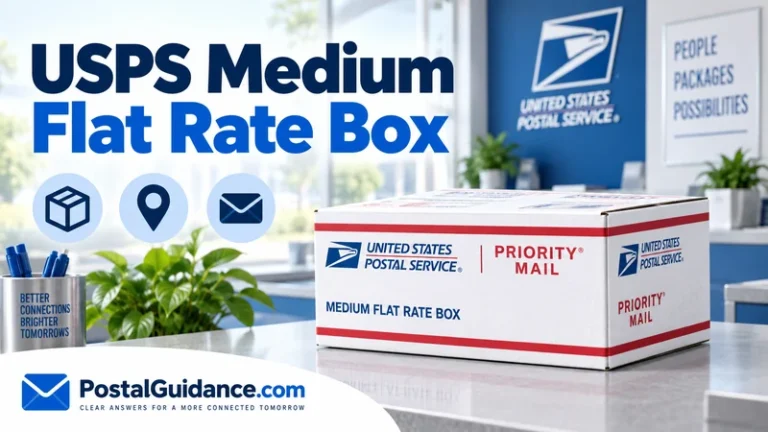
Priority Mail Flat Rate costs $13.90 for the envelope, $14.25 legal, $15.00 padded, $14.65 for the small box, $25.80 medium and $36.10 large ($34.65 APO/FPO/DPO). Priority Mail Express flat rate envelopes are $38.25, $38.55 legal and $39.25 padded. Prices in the rest of this article are the regular July 12, 2026 prices, which return January 18, 2027, and stamps, letters and Media Mail are not affected.
Is FedEx or USPS cheaper for each type of shipment?
If you are asking is fedex or usps cheaper for one specific package, match it to a row below. Then check the reasoning in the sections that follow.
| Shipment type | Usually cheaper | Why |
|---|---|---|
| Under 1 lb, retail, to a home | USPS | Ground Advantage starts at $7.90 and has no residential fee. FedEx Home Delivery adds a $4 per package surcharge. |
| 1 to 5 lb, moderate distance | USPS | A 5 lb parcel to zone 4 is $15.80 on Ground Advantage. |
| Fits a USPS flat rate box | USPS, but compare FedEx One Rate | Medium box $24.80, Large box $34.00, any weight up to 70 lb. |
| Heavy parcel, long distance | FedEx, if you have a discounted account | Ground Advantage to zone 8 reaches $39.45 at 10 lb. |
| Large but light box | Depends on the dimensional weight rules | Both carriers bill the greater of actual or dimensional weight. |
| Over 70 lb | FedEx | USPS tables stop at 70 lb. FedEx Ground accepts up to 150 lb. |
The fourth and sixth rows are where FedEx can win. The rest of this guide shows why, with prices you can check.
What does USPS charge for a light package?
USPS publishes its retail prices in Notice 123, so these figures are exact for July 2026. Ground Advantage prices rise with weight and with the zone, which is the distance band between the origin and the destination.
| Weight | Zone 1 | Zone 4 | Zone 8 |
|---|---|---|---|
| 1 lb | $9.55 | $10.60 | $12.90 |
| 2 lb | $10.80 | $13.00 | $19.05 |
| 5 lb | $12.95 | $15.80 | $26.05 |
| 10 lb | $15.95 | $19.40 | $39.45 |
| 20 lb | $22.75 | $27.30 | $69.40 |
| 21 lb | $26.25 | $35.05 | $78.50 |
Notice the jump between 20 and 21 lb. A zone 4 parcel rises from $27.30 to $35.05 for one extra pound, because the heavier price band starts there. Our Ground Advantage price table lists every weight.
Ground Advantage includes $100 of insurance, and the prices have no residential column. That is why a 2 lb parcel at $13.00 to zone 4 is hard to beat for a home delivery. For a full USPS price walkthrough, see how much it costs to ship a package with USPS.
When does FedEx cost less than USPS?
FedEx can win in three situations. One is a business account with discounts. Another is a heavy parcel, and a third is a boxed shipment that fits FedEx One Rate.
The second case is easy to see in the table above. A 10 lb parcel costs $19.40 to zone 4 but $39.45 to zone 8 on Ground Advantage. If a discounted FedEx quote lands below that, FedEx wins on long distances.
One Rate is a flat price by package type for expedited domestic services, and it is zoned, with local, regional and national bands. FedEx lists these 2Day local zone prices on its One Rate page as rates effective February 2, 2026, and they sit next to the matching USPS flat rate prices below.
| Size | FedEx One Rate 2Day | USPS Priority Mail Flat Rate |
|---|---|---|
| Envelope | $12.75 | $12.90 |
| Pak | $16.30 | $14.00 (padded envelope) |
| Extra small box | $13.40 | No equivalent |
| Small box | $19.55 | $13.65 (small box) |
| Medium box | $24.35 | $24.80 |
| Large box | $32.05 | $34.00 |
The boxes are not identical, so treat the rows as rough pairs. The FedEx small box comes in two shapes, 10.88 by 1.5 by 12.38 inches or 8.75 by 2.63 by 11.25 inches. The USPS small box is 8.63 by 5.38 by 1.63 inches inside and costs $5.90 less.
Regional and national zone prices run higher than the local figures shown, so a cross country One Rate box needs its own quote. The flat rate USPS price is the same to every zone, which is the main reason it wins on long distances.
One Rate has limits. Envelopes must weigh under 10 lb and boxes under 50 lb. It does not apply to international shipping, and packing materials are not included.
FedEx says $100 of declared value is included. Its pricing sheet states that the rate covers residential, delivery area and fuel surcharges. Account discounts do not apply to One Rate, and prices change, so check the page before you ship.
USPS also covers flat rate boxes up to 70 lb at the same price, which matters for dense items. Compare the options in our Priority Mail Flat Rate guide.
Does dimensional weight change the answer?
Yes, for any large parcel. Both carriers bill the greater of actual weight or dimensional weight, which is a size based weight. FedEx states this rule on its dimensional weight help page, but that page does not show the divisor, so use FedEx’s own calculator for a real figure.
USPS applies dimensional weight only to parcels over 1 cubic foot, or 1,728 cubic inches. It multiplies length, width and height in inches, rounding each up, and divides by 139. If the result exceeds 70 lb, the 70 lb price applies.
Take a box that measures 18 by 14 by 12 inches and weighs 6 lb. The volume is 3,024 cubic inches, which is over the 1,728 limit.
Dividing by 139 gives 21.76, which rounds up to 22 lb. The 6 lb box is priced as a 22 lb parcel, so zone 4 costs $40.65 instead of $16.35.
That is why a light, bulky box can change the winner. Run your measurements through the dimensional weight calculator before you compare quotes. A smaller box can save more than switching carriers.
Size has other costs on the USPS side. A Ground Advantage parcel longer than 22 inches adds $4.50, and one longer than 30 inches adds $10.00.
A parcel over 2 cubic feet adds $21.00. Between 108 and 130 inches of length plus girth, the oversized price applies, which is $173.45 to zone 4 regardless of weight.
Which USPS service is cheapest before you compare with FedEx?
Pick the right USPS service first, because the gap inside USPS can be bigger than the gap between carriers. Priority Mail costs more than Ground Advantage for the same parcel. A 2 lb parcel to zone 4 is $14.35 on Priority Mail and $13.00 on Ground Advantage.
The gap widens with distance and weight. A 5 lb parcel to zone 8 is $36.90 on Priority Mail and $26.05 on Ground Advantage. Priority Mail Express is higher again: $43.45 for 1 lb to zone 4, and $35.90 for its flat rate envelope.
So the fair test pairs like with like. Compare Ground Advantage with FedEx Ground, and Priority Mail flat rate with FedEx One Rate. Comparing Priority Mail Express with FedEx Ground would mislead you.
Is the cheaper carrier worth it if delivery is slower?
Price is only one part of the cost of a delay. FedEx lists Standard Overnight delivery by 5 in the evening for businesses and 8 for residences, and Priority Overnight by 10:30 in the morning. Those are expedited services with higher prices than Ground.
For a shipment that is not urgent, the cheaper ground service is almost always the right pick. For a deadline, price the express options on both sides and include the delivery day. Our guide on whether FedEx or UPS is faster covers the speed side.
Insurance rarely separates the two at low values. Ground Advantage and Priority Mail include $100 of insurance, and One Rate includes $100 of declared value. Add coverage only when the item is worth more.
Do residential fees and surcharges matter?
They matter more with FedEx. FedEx Ground Home Delivery has a $4 per package surcharge on residential addresses, according to the FedEx Ground page. FedEx also lists delivery area and fuel surcharges as separate items, though One Rate folds them into the box price.
USPS retail price tables show one price by weight and zone. Pickup on Demand costs $26.50 per pickup, so a drop off at a Post Office avoids that fee.
FedEx Ground limits are also larger. It takes parcels up to 150 lb, 108 inches long and 165 inches in length plus girth. A package that large cannot go with USPS at all, so price is not the deciding factor.
How do you compare the two for your own package?
Follow these steps and the cheaper carrier shows itself in a few minutes.
- Weigh the packed parcel and measure all three sides in inches.
- Work out the dimensional weight with the 139 divisor and use the larger number.
- Look up the USPS retail price by weight and zone, and check whether a flat rate box fits.
- Ask FedEx for a quote with your ZIP codes, and note any residential or delivery area charge.
- Compare the delivered total, plus insurance and delivery speed.
The shipping cost comparison tool puts the carriers side by side.
If you also weigh UPS, read UPS or USPS cheaper for that matchup.
The FedEx or UPS price comparison covers the other pair.
Bottom line on FedEx and USPS pricing
For most senders, is fedex or usps cheaper has a clear split. Pick USPS for light parcels, home deliveries and anything that fits a flat rate box. Look at FedEx when the parcel is heavy, oversized or discounted, or when One Rate matches your box, and let the delivery date break any tie.