One printed tape company will sell you a single roll for about 49 dollars. Another will not talk to you until you order 36 rolls. That gap is the first thing to know about custom packing tape.
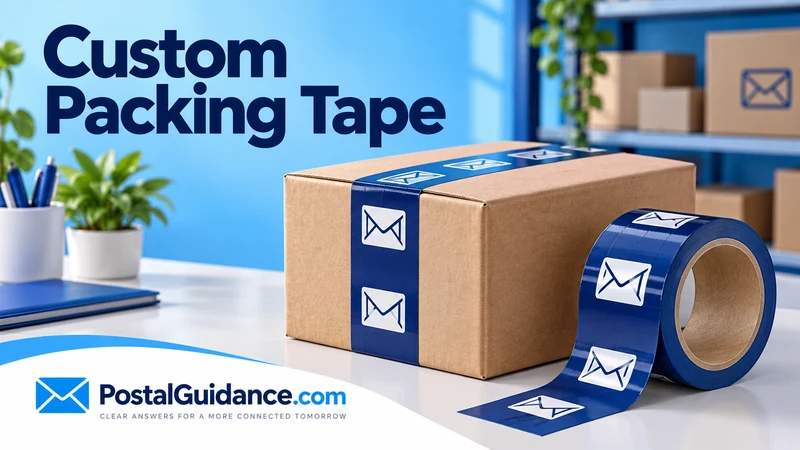
Custom packing tape means one of two things. It is either printed polypropylene tape, the clear or tan plastic type most stock tape is made from. Or it is printed water activated kraft tape, the brown paper kind you wet before it sticks.
Both can carry your logo. They are not priced the same way, and they are not the same product.
Below I go through what suppliers actually charge and what they let you print. Then how long you wait, and whether a cheap sticker beats the whole idea at your volume.
Printed poly tape vs custom water activated kraft tape
Printed polypropylene tape is the plastic tape you already know. It comes on standard dispensers. It sticks with pressure and prints in one to three colors on a clear, tan, or white background.
It is the cheaper option per roll at real volume. It also works with any tape gun you already own.
Custom water activated kraft tape is different. It is a paper tape with a starch based adhesive. You wet it with a sponge or a tape machine, and it bonds into the fibers of the box.
That bond is the whole point. Branding is a side benefit. The real reason to pay for kraft is that nobody can peel it off and reseal the box cleanly.
Neither type replaces the other. A seller shipping a couple hundred boxes a month from a garage usually reaches for poly tape. It is cheap and works with the gun already on the desk.
A brand pushing pallets through a fulfillment center often leans kraft instead. At that scale the tamper evident bond and machine dispensing both matter more.
Real minimum order quantities and price per roll for custom packing tape
Pricing on custom packing tape swings hard by supplier and by volume. Here is what five current suppliers actually publish, checked this month.
| Supplier | Tape type | Minimum order | Price per roll (approx) |
|---|---|---|---|
| UPrinting | Water activated paper | 1 roll | About 49 dollars for one 100 or 300 foot roll, dropping at 3, 6, 12, and 24 roll tiers |
| Sticker Mule | Water activated kraft | 100 feet | 19 dollars for 100 feet, falling to about 6.5 cents a foot at 15,000 feet |
| Uline | Printed polypropylene | 12 rolls | Around 6 dollars a roll at 24 rolls, down toward 4 dollars a roll past 360 rolls |
| Uline | Water activated kraft | 1 case (8 to 10 rolls) | 18 to 23 dollars a roll |
| Tape Jungle | Poly, PVC, or water activated paper | 36 to 40 rolls | Starting orders run 275 to 605 dollars total, a few cents per linear yard, cheaper by the pallet |
Read that table as two different games. UPrinting and Sticker Mule let you buy a small test batch first. You get to see your logo on a real box before you commit to anything bigger.
Uline and Tape Jungle assume you already know what you want. They reward you for buying by the case or the pallet, not the single roll.
Either way, your first order costs the most per roll. Real savings on custom packing tape only show up once you order by the case.
Watch for plate fees too. Uline, for example, adds a 50 dollar plate fee for one color kraft tape and 75 dollars for two. An exact PMS match is another 30 dollars per color.
The small batch printers fold setup into the roll price instead. That is part of why one roll costs 49 dollars.
A plate fee usually does not repeat on a reorder if your artwork stays the same. So lock your design before the first order. Tweaking the logo every few months means paying for new plates every few months.
What you can actually put on the tape
Color depends on who prints it, not on the tape type. The bulk suppliers cap you: Uline runs one or two ink colors on kraft, and Tape Jungle tops out at three.
The small batch shops are the opposite. UPrinting and Sticker Mule both print full color on water activated paper, so a gradient is fine there. Honestly, that is the one spot where the expensive single roll beats the cheap case.
Repeat length matters more than most first time buyers expect. Your logo prints once and repeats down the roll. Depending on the supplier, that repeat runs every 2, 3, 4, 6, or 12 inches.
A design built for a 12 inch repeat looks stretched or cramped on a 6 inch repeat. Match your artwork to the exact repeat length your supplier uses, not a generic template.
Print height is capped too. Uline allows 2.5 inches on its kraft tape, and the others land in the same range since the roll is under 3 inches wide. That rules out dense logos or long taglines.
Expect to be asked for a vector file. That means an AI, EPS, or clean PDF, not a JPEG pulled off your website.
A blurry logo is the usual reason a proof bounces back. Send the cleanest file you have and you skip a revision round.
How long it takes to get your first roll
Turnaround splits about as wide as pricing does. UPrinting quotes 3 business days for standard production. Sticker Mule quotes 4 days.
Both are built for fast, small batches. That speed comes with the higher per roll price shown above.
Uline runs slower. Poly tape ships in 13 business days after proof approval. A new water activated kraft order takes about 28 business days, and a reorder with no changes drops to 21.
Tape Jungle lands around 3 to 4 weeks total. That covers the proof, 12 to 15 days of production, and ground shipping. If you have a launch date, I would order six weeks out and treat anything faster as luck.
Tamper evident tape: when it actually matters
Poly tape can be peeled off a box and pressed back down. It leaves no obvious damage. That is fine for branding, but it is not a security feature.
Water activated kraft tape works differently. It bonds into the cardboard fibers instead of sitting on top of them. Pulling it off tears the box surface underneath.
A resealed flap on kraft tape is obvious from across the room. That is what tamper evident actually means. Suppliers print the phrase on a lot of things, but the torn cardboard is the part that counts.
If a resealed box is a real risk for you, kraft tape earns its higher price. Electronics, resale items, and anything a porch thief might target fall in that category. If you just want a branded look on a box that already ships safely, plain poly tape does the job for less.
Custom packing tape or branded stickers: which pays off first
Nobody selling tape wants to say this out loud. A printed sticker runs a few cents each in bulk. The minimums are tiny, and there is no roll to commit to.
Custom packing tape asks for more upfront. You commit to a fixed width, a fixed repeat length, and, at most suppliers, a dozen or more rolls before the price gets reasonable.
If it were me, under a couple hundred packages a month, I would buy the sticker. A printed sticker on the box flap or on your stock tape gets you the same branded unboxing moment for less money, with no wasted rolls if your logo changes.
Past 300 packages a month with a logo you trust, custom packing tape starts winning instead. That number is my own estimate from the minimums above, not an industry statistic. At that volume you burn through a 12 roll case anyway, the per package cost drops below a separate sticker step, and kraft tape throws in the tamper evident bonus.
Boxes matter here too. An unbranded box makes tape carry the whole visual load, so it is worth pairing custom tape with boxes printed with your own logo. If you ship in mailers instead of boxes, poly tape does not apply the same way, and custom printed poly mailers are usually the better first branding purchase.
Bottom line
Custom packing tape earns its cost once you have a logo you trust and enough volume to use a full case, not a single roll. Below that volume, a plain roll from our general packing tape guide paired with a cheap sticker beats a custom order almost every time.
If you want the standard brand at a fair price with none of the custom printing decisions, the rundown on Scotch brand packing tape covers that instead. Before you order any custom roll sized to a specific box, run the numbers through our dimensional weight calculator, so you are not printing tape for a box that already costs too much to ship.