Every American pays the same stamp price no matter how far the letter travels. A city block costs the same as a village in rural Alaska. That single fact explains most of what USPS is: a government body built to connect the whole country, not a company chasing profit on easy routes.
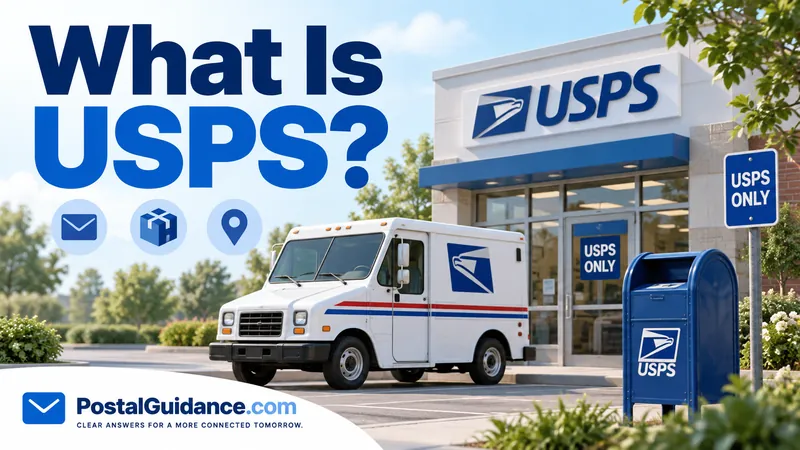
What is USPS, exactly
In plain terms, it is an independent establishment of the executive branch. It was created in its current form by the Postal Reorganization Act of 1970.
It is not a private company. No shareholder owns any part of it. It also is not a typical federal agency run directly by a cabinet department.
USPS sits in its own category. A presidentially appointed Board of Governors oversees it, but day to day management runs independently of Congress and the White House.
Where USPS actually came from
The story starts in 1775. The Second Continental Congress appointed Benjamin Franklin as the first Postmaster General that year.
The Postal Clause of the Constitution gave Congress the power to establish post offices and post roads in 1787. The Post Office Act of 1792 then made the postal system a permanent fixture of the federal government.
Those early laws protected the privacy of personal mail. They also helped the young country’s information move, a mission that still shapes USPS today.
Is USPS funded by taxpayers
Mostly no, and this is the part people get wrong most often. USPS generally receives no tax dollars for its operating expenses. It funds itself through the sale of stamps, postage, and shipping services.
The honest nuance is that this self funded model is under real strain in 2026. USPS posted a large net loss in the prior fiscal year. Postal leadership has asked Congress to double its Treasury borrowing authority to 30 billion dollars.
Congress has also debated privatization and deeper changes to the agency’s finances. USPS is not taxpayer funded for routine operations, but its ability to keep operating without new congressional action is a live 2026 debate, not a settled fact.
The universal service obligation
USPS operates under something called the universal service obligation. It must deliver to every address in the country, remote and rural ones included, at one uniform price.
That single requirement is the core difference between USPS and a private shipper. A private carrier can simply decline a route that loses money. USPS generally cannot.
Six day delivery is part of that same obligation. Congress has attached a six day mandate to postal funding for decades. That is why USPS still delivers mail on Saturday, even as private letter volume keeps shrinking.
How big USPS actually is
The scale is hard to overstate. In fiscal year 2025, USPS delivered mail and packages to 170.4 million delivery points nationwide. That reaches nearly every residence, business, and PO Box in the country.
It operated 30,972 retail offices and maintained 236,347 delivery routes. Its vehicle fleet totaled 262,740 units, one of the largest civilian fleets in the world.
USPS itself notes that if it were a private sector company, its revenue would place it among the largest firms in the country on the Fortune 500 list. Those figures come from the Postal Service’s own Postal Facts data, which updates as new fiscal year numbers arrive.
What is USPS in raw numbers, then? A government institution operating at a scale few agencies of any kind can match. Its full mission is on the official About USPS profile page.
How USPS differs from UPS and FedEx
UPS and FedEx are publicly traded companies with shareholders and profit targets. They can decline unprofitable routes and set prices freely. Neither is bound by anything resembling a universal service requirement.
USPS instead answers to Congress and the Postal Regulatory Commission. That limits how much it can raise prices on market dominant products like First-Class Mail. It is one reason a stamp still costs a fraction of a private courier’s cheapest rate.
Delivery infrastructure overlaps more than people assume. UPS and FedEx both hand off lightweight residential packages to USPS for the final leg of the trip. Our guide on what UPS actually stands for covers that company’s separate, private sector history.
If you are choosing between carriers for an actual shipment, our cost comparison across carriers lines up current USPS, UPS, and FedEx pricing side by side.
What USPS actually does day to day
Beyond letters and packages, USPS runs passport acceptance at thousands of locations. It handles Election Mail and Political Mail under federal rules, and moves military and diplomatic mail worldwide.
It also remains the default carrier for First-Class Mail, the everyday class that still underwrites much of the network. None of that changes its basic legal identity.
USPS is a government institution funded by what it sells. It is obligated to serve every address, and it answers to Congress rather than to shareholders.
Why the question keeps coming up
People ask what is USPS most often after seeing a headline about postal losses or a privatization proposal. The confusion is understandable, since USPS looks like a business, prices like a business, and even competes with private shippers on packages.
Legally and structurally, it is still something else entirely. Knowing that distinction explains why USPS cannot simply drop an unprofitable rural route the way a private carrier might, and why Congress, not a boardroom, ultimately decides its biggest structural questions.
The bottom line
What is USPS, in one line? It is an independent, self funded arm of the federal government, born in 1775, bound by a universal service obligation that no private carrier shares.
It is not taxpayer funded for daily operations, though its finances face real pressure and real political debate in 2026. That mix of scale, obligation, and independence is what separates USPS from UPS, FedEx, and every other shipper you might compare it to.