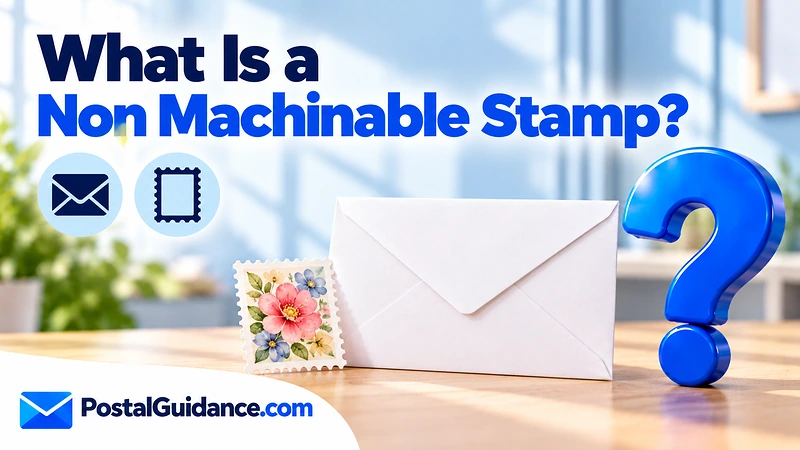
What is a non machinable stamp? It is a Forever stamp sold at the First-Class Mail nonmachinable surcharge price, which is $1.31 today ($0.82 for a stamped 1 oz letter plus the $0.49 surcharge). It goes on letters that sorting machines handle poorly, such as a square invitation or an envelope with a button closure.
USPS issues these stamps with a new design from time to time. The current design is the Luna Moth, issued August 16, 2025 in Schaumburg, Illinois, at the surcharge rate of the day, $1.27. The Postal Store now lists a pane of 20 at $26.20, which works out to $1.31 each.
USPS describes it as a nondenominated stamp for irregularly sized envelopes such as square greeting cards, invitations and announcements. In its words, like a Forever stamp it will always be valid for the rate printed on it, so a pane bought in 2025 still covers today’s surcharge price.
How much is a non machinable stamp in 2026?
The price follows the current letter price, because the stamp is a Forever type. USPS rules say these stamps always equal the applicable price for the category printed on them. If rates rise, a stamp you bought earlier still covers the new amount.
The first such stamp came out in 2015 with a butterfly design at 71 cents. That is why older packs show a lower number than the current $1.31. Each stamp counts at the full current value, not the price it sold for.
| Piece | Postage with stamps | How it is built |
|---|---|---|
| Machinable 1 oz letter | $0.82 | One Forever stamp |
| Nonmachinable 1 oz letter | $1.31 | $0.82 plus $0.49 surcharge |
| Machinable 2 oz letter | $1.11 | Stamped 2 oz price |
| Nonmachinable 2 oz letter | $1.60 | $1.11 plus $0.49 surcharge |
The surcharge is charged once per piece. It does not grow with each extra ounce. Metered mail pays $0.78 for 1 oz, so a metered nonmachinable letter costs $1.27.
A 3 oz invitation in a square envelope pays the $1.40 stamped 3 oz price plus $0.49, or $1.89. Letters top out at 3.5 oz. For more weights, see the guide on current USPS stamp prices.
What is a non machinable stamp used for?
It pays the surcharge on letters that meet one or more of the nonmachinable traits in DMM 101 section 1.2. The list is specific, so you can check an envelope with a ruler and your fingers.
- An aspect ratio (length divided by height) below 1.3 or above 2.5.
- A polybag, polywrap or any plastic enclosure, or an outer surface made of something other than paper.
- Clasps, strings, buttons or similar closure devices.
- Items such as pens, pencils, keys or coins that make the thickness uneven, or loose keys and coins inside.
- Too rigid: the piece must bend easily around an 11 inch turn under 40 pounds of belt tension.
- Less than 0.009 inch thick when the piece is more than 6 inches long or 4 1/4 inches high.
- An address parallel to the shorter side of the piece.
- A self mailer or booklet that is not prepared to USPS standards.
Paper windows do not make an envelope nonmachinable. Attachments that the eligibility standards allow do not either.
The thickness rule trips up thin items. A single folded sheet in a long envelope can fall under 0.009 inch. A keepsake taped inside, such as a coin or key, makes the thickness uneven and triggers the surcharge as well.
How can you check a letter in four steps?
- Measure the long and short sides and divide long by short. Anything under 1.3 or over 2.5 is nonmachinable.
- Look at the outside. Plastic, strings, buttons and clasps all count.
- Squeeze the contents. Stiff inserts, lumps or coins mean it is too rigid or uneven.
- Check that the address runs along the long side.
One failed step is enough. You do not pay the surcharge twice for several problems.
When in doubt, test the envelope before you buy a pack. Mail a sample to yourself, or ask a counter clerk to weigh and price the finished piece. Do this before you stamp a full set of 100 invitations.
How do you check the aspect ratio?
Divide the long side by the short side. A 6 by 6 inch square gives 1.0, so it needs the surcharge. A 5 by 8 inch envelope gives 1.6 and passes, while a 4 by 11 inch slim envelope gives 2.75 and fails.
Event mailings often fail this test. Square invitations are the classic case, and tall narrow ones fail too. The article on stamps for wedding invitations covers a full set with inserts.
Envelope feature versus machinable status
| Envelope feature | Status | Reason |
|---|---|---|
| Square envelope, 6 by 6 inches | Nonmachinable | Ratio of 1.0 is under 1.3 |
| Standard rectangle, ratio 1.6 | Machinable | Ratio between 1.3 and 2.5 |
| Very narrow envelope, ratio 2.75 | Nonmachinable | Ratio over 2.5 |
| Paper envelope with a window | Machinable | Paper windows are allowed |
| Button and string closure | Nonmachinable | Closure device |
| Metal clasp closure | Nonmachinable | Clasps and similar devices |
| Plastic or polybag outer layer | Nonmachinable | Non paper exterior |
| Key or coin taped inside | Nonmachinable | Uneven thickness |
| Stiff card insert that will not bend | Nonmachinable | Too rigid |
| Thin, flimsy piece over 6 inches long | Nonmachinable | Under 0.009 inch thick |
| Address along the short side | Nonmachinable | Address orientation |
When does a letter stop being a letter?
The surcharge applies only to letter size pieces. A domestic letter can be as large as 11 1/2 by 6 1/8 inches and 1/4 inch thick, and it can weigh up to 3.5 oz. The minimum is 5 by 3 1/2 inches and 0.007 inch thick.
Go past those limits and the piece becomes a large envelope or a parcel, which has its own prices. Large envelopes that are rigid, nonrectangular or not uniformly thick pay parcel prices. A thick keepsake box in an envelope is a good example.
Can you use regular stamps instead?
Yes, because USPS only needs the postage to add up. Any stamps totaling at least $1.31 cover a 1 oz nonmachinable letter. Two regular Forever stamps total $1.64, which overpays by $0.33.
A stamp built for the surcharge price is the clean way to do it, because one stamp avoids a crowded corner and keeps its value if prices change. Postage must sit in the upper right corner of the address side. The page on where to put a stamp on an envelope shows placement.
Knowing what is a non machinable stamp also helps with thick mailings. Big invitations may need a 2 oz price anyway. The guide to the 2 ounce stamp explains that price.
What happens if you use only a regular stamp?
A nonmachinable letter with only $0.82 on it is underpaid by $0.49. Underpaid mail can be delayed or returned. Neither result is good for an invitation or a formal letter.
A simple fix is to ask a clerk at a Post Office counter to price the envelope. The stamp calculator also lets you enter the weight and the stamps you own.
Does a postcard need the surcharge?
No, because pieces mailed at the card price are exempt from the surcharge. The retail postcard price is $0.65 for a card up to 6 by 4 1/4 inches. A greeting card in an envelope is different, so see stamps for a greeting card if the envelope is square.
Where can you buy a non machinable stamp?
The Postal Store at store.usps.com lists the current surcharge stamp, and Post Offices are the other place to ask. Some retailers carry only the standard Forever stamp.
A full list of sellers is in the guide on where to buy stamps.
If the stamp you find is a standard Forever, remember that its value is $0.82. The word “Forever” alone does not tell you which price it covers. Look for the surcharge wording on the product page or pane.
Bottom line on the surcharge stamp
So what is a non machinable stamp worth today? It is $1.31, and one stamp covers a 1 oz nonmachinable letter. Measure the aspect ratio first, then check the closure and the thickness.
Pay the surcharge only when a rule in DMM 101 applies. How any Forever stamp keeps its value is in the explainer on the Forever stamp.