
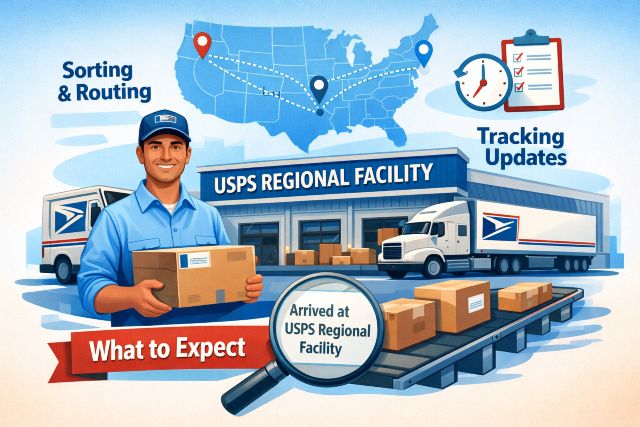
A USPS Regional Facility is a large mail processing center where packages are sorted, routed, and prepared for the next stage of their journey.
When a package reaches this point, USPS systems decide where it should go next, not when it will be delivered. That distinction matters and is the root of most confusion.
Regional facilities sit between:
-
National processing hubs
-
Local post offices
They act as routing checkpoints that move mail closer to the correct geographic area. This is why many tracking updates mention a regional facility even though delivery still feels far away.
If you’ve seen tracking messages like Arrived at USPS Regional Facility or Departed USPS Regional Facility, your package has entered this internal logistics stage.
Why USPS Uses Regional Facilities
USPS handles millions of packages every day. Moving all of them directly from origin to destination would be inefficient and chaotic.
Regional facilities allow USPS to:
-
Consolidate mail moving in the same direction
-
Optimize transportation routes
-
Balance volume across the network
This system is especially important for ground-based services such as USPS Ground Advantage and USPS Parcel Select, where efficiency matters more than speed.
What a USPS Regional Facility Is Not
A regional facility is not:
-
A delivery location
-
A local post office
-
A sign that something is wrong
It’s simply part of how USPS organizes large-scale package movement. Most packages pass through at least one regional facility before reaching their destination.
What Happens to a Package at a USPS Regional Facility?
When a package arrives at a USPS Regional Facility, it enters a processing stage focused on sorting and routing, not delivery.
At this point, USPS systems scan the package and determine:
-
Which general direction it needs to travel
-
Which transportation route makes the most sense
-
When it can move based on capacity and service level
This is why tracking updates at this stage are often broad and non-specific. The package is being prepared for movement, even if that movement is not immediately visible.
Why Tracking Looks Quiet at This Stage
Regional facilities handle mail in large batches, not as individual handoffs. Because of this, tracking updates may pause while packages are grouped and loaded for outbound transport.
This behavior is common for ground-based services and long-distance shipments. Seeing USPS tracking not updating during this stage is usually normal and does not indicate a problem.
How Long Packages Usually Stay Here
There is no fixed timeline for how long a package remains at a regional facility.
In many cases, it stays for:
-
A short processing window
-
One or two business days
-
Slightly longer during high-volume periods
The key thing to understand is that time spent here is part of normal USPS flow, not a delay by default.
USPS Regional Facility vs Distribution Center
A USPS Regional Facility and a USPS Distribution Center are both part of the USPS processing network, but they serve different purposes.
Distribution centers are designed to handle very large volumes of mail coming from many regions at once. They focus on breaking down national or multi-state shipments into more manageable flows.
Regional facilities operate one level closer to the destination. Their role is to direct mail toward the correct geographic area rather than simply processing volume.
Because of this structure, a package may move from a distribution center to a regional facility, then continue onward to another facility or a local post office.
Why Tracking Uses Different Facility Names
USPS tracking reflects where a package was scanned, not how close it is to delivery.
That’s why one shipment may show a distribution center while another shows a regional facility. These labels describe internal processing roles, not urgency or delay.
Understanding this distinction helps explain why tracking can feel inconsistent even when a package is moving normally.
USPS Regional Facility vs Local Post Office
A USPS Regional Facility is part of USPS’s internal logistics network, while a local post office is part of the final delivery stage.
Regional facilities handle sorting and routing decisions. They do not deliver packages to homes or businesses. Local post offices receive mail that is already assigned to a delivery route and a mail carrier.
This difference explains why a package can appear to move through multiple facilities before reaching the post office that serves its destination.
Why Packages Don’t Go Straight to the Post Office
USPS routes mail based on efficiency, volume, and transportation availability.
Because of this, packages are often grouped with others heading in the same direction before being sent onward. This approach helps USPS manage large volumes without overwhelming local offices.
Seeing a regional facility in tracking does not mean a package is close to delivery. It simply means it is moving through the system as designed.
What Does “Arrived at USPS Regional Facility” Mean?
When tracking shows Arrived at USPS Regional Facility, it means your package has reached one of USPS’s regional processing hubs and has been scanned into that location.
This status confirms arrival only. It does not mean the package is out for delivery, delayed, or stuck. It simply indicates that the package is now inside the regional routing stage of the USPS network.
At this point, USPS systems are preparing the package for its next move by grouping it with other shipments traveling in the same general direction.
Why This Status Can Appear for a While
Seeing this message for more than a day is common.
Regional facilities process large volumes of mail, and packages move forward based on transportation schedules rather than individual urgency. During this time, tracking may not change even though the package is still progressing internally.
On its own, this status is neutral and part of normal USPS operations.
What Does “Departed USPS Regional Facility” Mean?
When tracking updates to Departed USPS Regional Facility, it means your package has completed processing at that facility and has been sent onward.
This status confirms that the package is no longer at the regional facility and is moving to the next point in the USPS network. That next stop could be another processing facility or a local post office, depending on the route.
Why Updates May Slow After Departure
After a departure scan, packages can travel long distances without additional scans. USPS does not track movement between every location.
As a result, tracking may remain unchanged until the package reaches the next major facility. This gap is normal and does not mean the package has stopped moving.
What Does “In Transit to Next Facility” Mean?
When tracking shows In Transit to Next Facility, it means your package has left one USPS location and is currently traveling to another, but has not yet been scanned at its next stop.
This is a system-generated status that indicates movement without confirming a specific location. It’s commonly used during longer ground transport segments or when packages are moving between major facilities.
Why This Message Can Repeat
This message may appear multiple times even if the package hasn’t changed locations recently. USPS systems refresh tracking periodically to show that the shipment is still active.
On its own, this status is normal and does not signal a delay. It simply reflects how USPS tracks packages while they are between scans.
When a USPS Regional Facility Delay Is Actually a Problem
In most cases, time spent at a USPS Regional Facility is normal. However, there are situations where a delay may deserve attention.
A delay may be worth watching if:
-
Tracking has not changed for an extended period
-
The delivery estimate has disappeared or shifted significantly
-
The same status repeats far beyond the typical window
That said, USPS regional facilities handle volume in waves. What looks like a delay on the surface is often a backlog clearing in batches rather than a single package being held aside.
Common Reasons Delays Happen
Delays at regional facilities are usually caused by system-wide factors rather than individual package issues. These can include:
-
High seasonal volume
-
Weather disruptions
-
Transportation constraints
-
Staffing or capacity limits
In these cases, packages continue moving once conditions normalize, even if tracking does not immediately reflect progress.
What a Delay Does Not Automatically Mean
A delay at a regional facility does not automatically mean:
-
Your package is lost
-
Your package is damaged
-
Your package needs action from you
Most shipments resume normal movement without intervention. Situations where action is needed are rare and usually accompanied by clearer tracking messages or alerts.
Why USPS Regional Facilities Appear So Often in Tracking
USPS Regional Facilities appear frequently in tracking updates because they are central checkpoints in how USPS moves mail across the country.
Most packages do not travel in a straight line from sender to recipient. Instead, they move through a network designed to consolidate volume, optimize routes, and balance capacity. Regional facilities sit at key points in that network, which makes them visible in tracking more often than smaller locations.
Why the Same Facility Name May Show Up More Than Once
It’s not unusual to see the same regional facility mentioned multiple times in tracking.
This can happen when:
-
Packages are scanned during different processing stages
-
Mail is temporarily staged before outbound transport
-
System updates reflect internal routing decisions
These repeated mentions usually indicate internal movement rather than backtracking or errors.
Why Tracking Language Feels Vague at This Stage
Tracking messages tied to regional facilities are intentionally broad. USPS prioritizes operational efficiency over detailed public-facing updates.
Because of this, tracking focuses on status changes, not step-by-step movement. While this can feel unclear, it reflects how USPS manages large-scale logistics rather than an issue with your specific package.
Final Takeaways About USPS Regional Facilities
A USPS Regional Facility is a normal and essential part of how USPS moves packages efficiently across the country.
Seeing this term in tracking does not mean something is wrong. In most cases, it simply means your package is being sorted, routed, and prepared for its next stage of travel.
Regional facilities are designed to handle volume, not individual deliveries. Because of that, tracking updates at this stage can feel slow or vague even when everything is moving as expected.
Understanding what a regional facility does helps remove uncertainty and sets realistic expectations for delivery timelines, especially for ground-based shipping services.
This page serves as the foundation for understanding USPS tracking messages tied to regional processing, with more specific situations covered in dedicated articles.
USPS Regional Facility FAQ
What is a USPS Regional Facility?
A USPS Regional Facility is a large mail processing center where packages are sorted and routed before moving closer to their destination. These facilities do not deliver mail. They exist to manage volume and direct shipments efficiently across regions.
Is a USPS Regional Facility the same as a distribution center?
No. While both are processing locations, they serve different roles. A USPS Distribution Center focuses on breaking down very large volumes of mail, while a regional facility focuses on routing mail toward the correct geographic area.
Does “Arrived at USPS Regional Facility” mean my package is close?
Not necessarily. This status means the package has entered regional processing, not that delivery is imminent. Packages often pass through one or more regional facilities before reaching a local post office.
How long do packages usually stay at a USPS Regional Facility?
There is no fixed timeline. Most packages stay for a short processing window, but time can vary depending on volume, transportation schedules, and service type. Short pauses at this stage are normal.
Is my package stuck if tracking hasn’t updated?
Not usually. Limited or paused updates are common while packages are grouped and moved in batches. This is especially true for ground-based services.
When should I actually be concerned?
Concern is reasonable only when:
-
Tracking has not changed for an unusually long time
-
The delivery estimate disappears entirely
-
USPS tracking shows an explicit exception or alert
In most cases, packages move on without any action needed.
very helpful post. got the answers i was looking for, thanks!