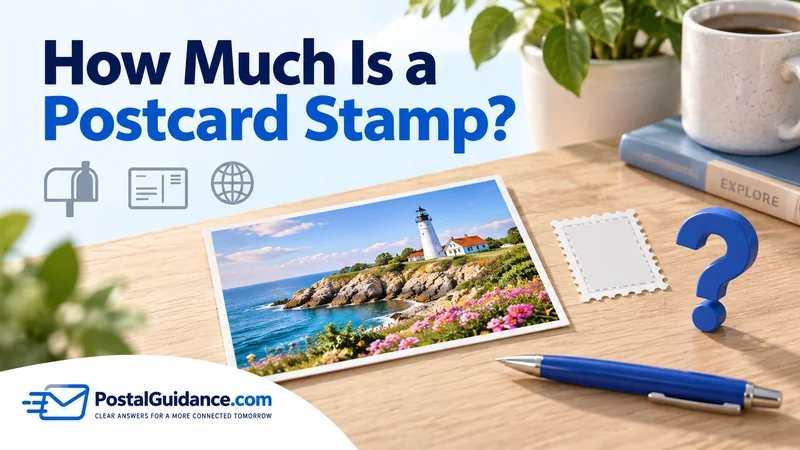
A postcard costs 65 cents to mail within the United States in 2026. That is how much is a postcard stamp for a standard size card sent to a domestic address. It is a separate rate from the 82 cent Forever stamp used on letters.
The rate only applies if the card actually meets the postal definition of a postcard. Size, shape, and destination all change what you owe. This guide covers each one, plus where to actually buy the right stamp.
How much is a postcard stamp right now
USPS raised the domestic postcard rate to 65 cents on July 12, 2026. That followed an increase to 61 cents in July 2025. Before that, the postcard rate was 56 cents.
International postcards cost more. They run $1.75 per card as of the same July adjustment, the same rate charged for a one ounce international letter.
| Mail type | 2026 rate |
|---|---|
| Domestic postcard | $0.65 |
| Domestic First-Class letter (Forever) | $0.82 |
| International postcard or letter | $1.75 |
USPS sells stamps denominated specifically at the postcard rate. The Postal Store currently lists a Postcard design priced at 65 cents each. That is separate from the Forever stamps sold for letters, even though both count as First-Class Mail.
Postcard rate vs letter rate: why they differ
The postcard rate sits below the one ounce letter rate. A postcard weighs less and needs less handling than a folded, sealed envelope. USPS has kept that gap in place through every rate change in recent memory.
The gap has typically run 15 to 20 cents below the Forever price. It held steady at 17 cents through the July 2026 adjustment.
A Forever stamp still works on a postcard, since it covers more postage value than the card needs. You simply overpay the difference, and USPS does not refund it once the card is mailed.
What actually qualifies as a postcard
USPS defines a postcard by size and thickness, not by what is printed on it. A rectangular card qualifies for the postcard rate starting at 3.5 by 5 inches on the small end. The large end tops out at 4.25 by 6 inches.
Thickness matters too. A qualifying card must run between 0.007 and 0.016 inches thick, roughly the stiffness of a standard index card.
| Dimension | Minimum | Maximum |
|---|---|---|
| Height | 3.5 inches | 4.25 inches |
| Length | 5 inches | 6 inches |
| Thickness | 0.007 inches | 0.016 inches |
These standards come from the USPS Domestic Mail Manual section on physical standards. Anything outside that window stops qualifying for the postcard rate, no matter how the seller markets it.
Placement matters as well, not just size. Our guide to where the stamp actually goes on the card covers the exact corner and why it affects sorting.
Oversized postcards: paying the letter rate instead
A 5 by 7 inch card is a common size for real estate mailers and photo prints. It is too large for the postcard rate. USPS mails it as a letter instead, at 82 cents rather than 65 cents.
Square or oddly shaped cards run into a separate problem. USPS adds a nonmachinable surcharge, currently 49 cents, on top of the base rate. That surcharge applies to anything that is not a standard rectangle its equipment can run through automated sorting.
Senders in postcard trading communities report mixed experiences getting oddly shaped cards through without the extra postage. The safest move is paying the surcharge and asking for a hand cancel at a counter.
Where to buy a postcard stamp
The Post Office counter and USPS.com are the most reliable sources for postcard rate stamps. Most grocery store and pharmacy racks stock Forever books far more often than postcard denominated ones.
Our guide to where stamps are sold near you covers the full retail landscape for both types. Overpaying 17 cents per card adds up fast for frequent senders. Ordering postcard stamps directly from USPS is worth the extra step in that case.
A full book of stamps costs $13.00 at the postcard rate. That compares to $16.40 for the equivalent Forever book.
International postcards need their own stamp too
A postcard mailed outside the country needs $1.75 in postage, the same as an international letter. USPS sells a Global Forever stamp that covers exactly that rate. One stamp is enough regardless of the destination country.
In May 2026, USPS issued a set of Global Forever designs specifically themed around the Postcrossing postcard exchange community. The designs changed, but the postage value stayed at the standard international rate. A regular domestic postcard stamp is not enough on its own for anything leaving the country.
Sending several postcards at once
How much is a postcard stamp when you are mailing a whole batch, like wedding announcements or holiday cards? The math stays simple. Multiply 65 cents by the number of cards, since each one needs exactly one postcard stamp.
A book of 20 postcard stamps covers 20 cards for $13.00. Two books cover 40 cards, and so on, with no bulk discount built into the price at any quantity.
Why the postcard rate keeps rising
USPS adjusted the postcard rate twice in 2026 alone, in April and again in July. Both changes tracked the same broader mailing services price increases that pushed the Forever rate up too.
Since 2023, USPS has settled into roughly two adjustments a year rather than one. Current postcard stamps are marked Forever, not a fixed cent value, so they keep working at whatever the postcard rate is when you use them.
The bottom line
How much is a postcard stamp comes down to 65 cents for a standard domestic card in 2026. It runs $1.75 if the card is headed outside the country. Size and shape decide whether that rate even applies, and an oversized or square card can quietly cost more.
Check the exact postage for anything unusual with our postage price calculator before you drop it in the mail. See our current stamp prices across the board for every other mail type.